Service
Sewer Line Repair
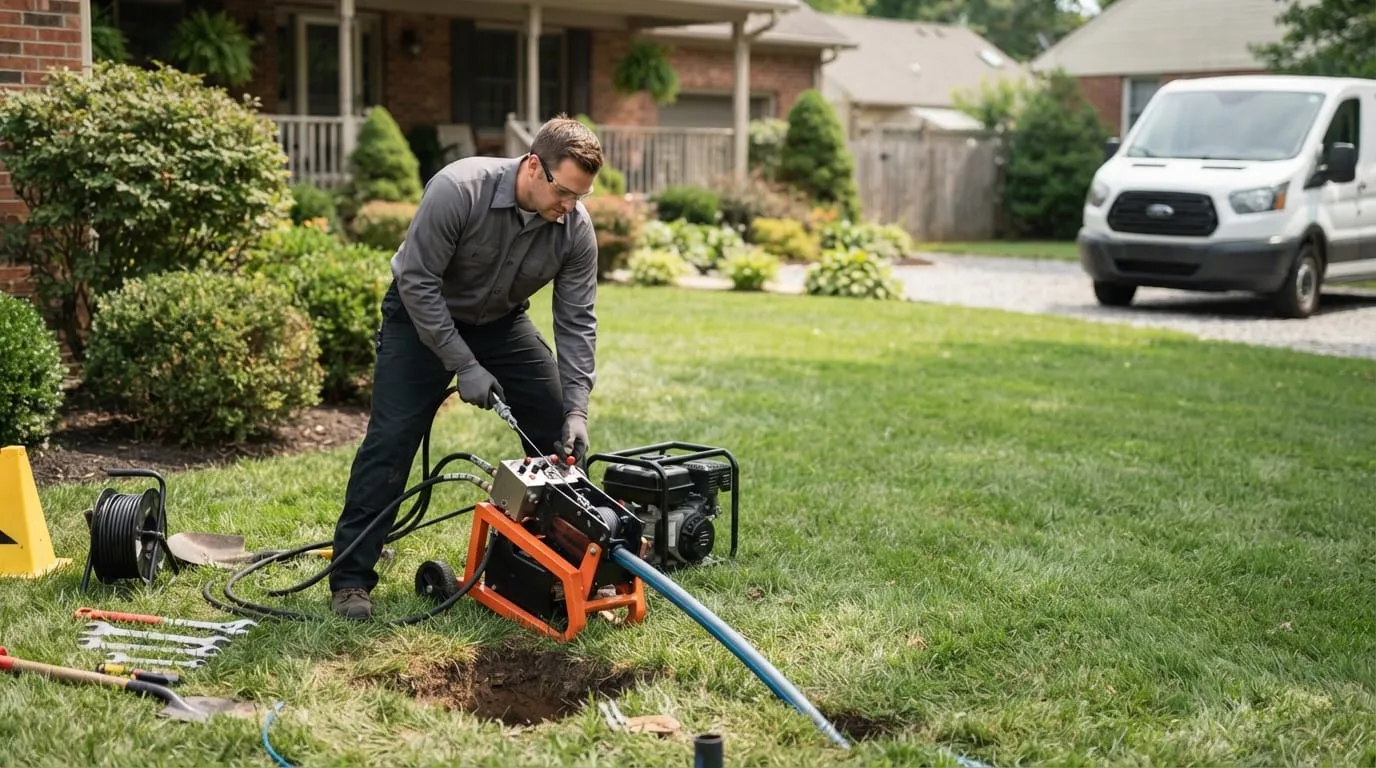
Camera-verified repair and replacement of cracked, collapsed, root-damaged or bellied sewer laterals, including trenchless lining and pipe bursting.
Free call-routing service. An independent licensed plumber does the work and quotes you directly.
- Licensed and insured
- Price agreed before work
- A plumber who works your area
A sewer line failure is one of the most disruptive plumbing problems a home can have, and one of the most misdiagnosed. Homeowners often pay for cleaning after cleaning before anyone puts a camera in the line. Our sewer line repair service connects you with a licensed local plumber who inspects first, shows you the defect, and explains every repair option, including trenchless methods that avoid digging up the yard.
Why sewer laterals fail
The lateral is the pipe that carries everything from your house to the municipal main or septic tank. Depending on when the home was built, it may be vitrified clay, cast iron, Orangeburg fiber pipe, ABS or PVC. Clay and cast iron dominate homes built before the 1980s. Clay joints separate and admit roots. Cast iron corrodes from the inside until the bottom of the pipe is gone. Orangeburg, used in some mid-century construction, deforms and collapses. Even modern PVC can be bellied by settling soil or crushed by vehicles.
Soil matters. Expansive clay soils that swell when wet and shrink in drought move laterals enough to offset joints. Sandy soils and high water tables let pipes settle and let groundwater infiltrate. Mature trees anywhere near the line send roots toward the moisture at any crack or joint.
Repair methods
A spot repair excavates and replaces a short failed section, and is often the right answer for a single crushed or broken spot in a line that is otherwise sound. Cured-in-place pipe lining creates a new pipe inside the old one and is well suited to cracked or root-damaged lines that still hold their shape. Pipe bursting replaces the whole run with new pipe along the same path with only two access pits. Full open-trench replacement is used when the line has collapsed, has severe bellies, or has a slope problem that lining would preserve.
What to expect
The plumber runs a camera and locates the defect, then explains what they found in plain terms and what each repair would cost. Sewer work almost always requires a permit and an inspection, which the plumber arranges. When the job is finished a final camera run shows the completed repair, and you keep the recording.
Does this sound familiar?
Problems this service solves
- Cracked or collapsed clay, cast iron or Orangeburg sewer laterals
- Root intrusion through joints and cracks that blocks the line repeatedly
- Bellied or sagging sections where waste settles and clogs
- Offset joints from soil movement or foundation settling
- Corroded cast iron under slabs that has lost its bottom half
- Sewer lines crushed by heavy vehicles or construction
Signs you need sewer line repair
If more than one of these is true, the problem is usually past the point a plunger or a store-bought cleaner will fix.
- Backups that return within weeks of a professional cleaning
- Multiple drains in the house slow or gurgling at the same time
- Sewage odor in the yard, basement or near cleanouts
- Unusually green or soggy patches of lawn over the lateral route
- Sinkholes, depressions or cracks along the path of the sewer line
- Pest or rodent activity that suddenly increases around the house
What to expect
How the visit works
Camera inspection and locating
A camera is run through the line to record the defect, its depth and its distance from the cleanout, so the repair is planned for the exact spot rather than a guess.
Options laid out with costs
Spot repair through a small excavation, cured-in-place lining, pipe bursting to install new pipe along the old route, or full replacement, each explained with what it fixes and what it does not.
Permits and utility locates
Sewer work requires a permit in most jurisdictions and utility locating before digging. The plumber handles both and coordinates any required inspection.
Repair, test and final camera
The repaired line is tested, inspected where required, and a final camera run confirms the defect is gone and flow is unrestricted.
What's included
What you get on every job, whoever we send.
- Video evidence of the problem before you commit to a repair
- Trenchless methods that preserve driveways, landscaping and slabs where the pipe allows
- Licensed plumbers who know the pipe materials common in your area's housing stock
- Permit and inspection handling included
Local pages
Sewer Line Repair by city
Local pages for this service, covering the problems, housing and water conditions specific to each area.
Questions
Sewer Line Repair questions
How do I know if the problem is my sewer line or just a clog?
A clog affects one fixture or one branch. A sewer line problem affects the lowest drains first and often several at once, produces gurgling when fixtures are used, and comes back after cleaning. A camera inspection after a cleaning settles the question and shows exactly what is wrong.
What is trenchless sewer repair?
Trenchless methods repair or replace the pipe from access points instead of digging along its whole length. Cured-in-place lining pulls a resin-saturated liner through the old pipe and hardens it into a new pipe within the old one. Pipe bursting pulls a new pipe through while breaking the old one outward. Both need only small excavations at each end, but the existing pipe must have enough shape and slope for them to work.
Who is responsible for the sewer line, me or the city?
In most places the homeowner owns and maintains the lateral from the house to the connection at the main, including the section under the sidewalk or street. The utility is responsible for the main itself. Some cities cover the portion in the right of way, so the plumber will tell you where the responsibility line is in your area.
How long does a sewer line repair take?
A spot repair or a lining job is usually completed in a day. Pipe bursting and full replacement of a long lateral can take one to three days depending on depth, length, soil and permit inspections. The plumber will tell you whether you can use your drains during the work.
Will my yard or driveway be destroyed?
Not necessarily. Trenchless methods require only small access pits, typically at the house and near the property line. Where an open trench is unavoidable, such as a collapsed section that cannot be lined, the plumber will explain exactly where it will run and what restoration is included.
Related services
Sewer Cleaning
Clearing main sewer line blockages and root intrusions with heavy-duty cabling and hydro jetting, with camera inspection to confirm the line is clear.
See what this coversLeak Detection
Locating hidden water leaks under slabs, inside walls, in yards and at the meter using acoustic, thermal and pressure-testing equipment, then repairing them.
See what this coversWater Heater Repair
Diagnosis and repair of gas, electric and tankless water heaters, including no-hot-water calls, leaks, pilot problems and sediment flushing.
See what this coversPipe Repair
Repair and replacement of burst, leaking, frozen, corroded or noisy water pipes, from a single fitting to a whole-house repipe in copper or PEX.
See what this covers

Get it fixed
Sewer Line Repair, handled locally
Call with your ZIP code and what you are seeing. We route you to a licensed plumber in your area who does sewer line repair every week.
Free call-routing service. An independent licensed plumber does the work and quotes you directly.
- Licensed and insured
- Answered 24/7
- Price before work