Service category
Pipe Services
Repair, replacement and repiping of supply lines in copper, PEX, galvanized steel and PVC, including burst, frozen and corroded pipe.
Free call-routing service. An independent licensed plumber does the work and quotes you directly.
- Licensed and insured
- Price agreed before work
- A plumber who works your area
There is a point where repairing pipe stops making sense. Every joint in an original galvanized system is the same age in the same condition, so a repair fixes the one that failed and leaves the rest queued behind it. A plumber should tell you which situation you are in.
Knowing when to stop repairing
The useful question is not whether a pipe can be repaired but whether it should be.
Galvanized steel supply is the clearest example. It fails from the inside: the zinc coating goes first, then the steel rusts, closing the bore and thinning the wall. Two symptoms arrive together, pressure that has been declining for years and rust in the first water of the morning, and then it starts leaking at threaded joints where the wall is thinnest.
Finding that leak is not usually difficult. The harder question is whether to repair it, and in a house where the supply is original the honest answer is often no.
Freeze damage is a two-part job
A pipe that burst in a freeze needs the split section replaced, but the repair is only half the work. The reason it froze was that it runs through an unheated space with no insulation, and that has not changed.
Where the vulnerable pipe sits depends on how the house was built. In raised construction it is in the crawl space under the floor. In slab-on-grade it is usually in the attic, which gets far colder than the rooms below. Knowing which you have tells you where to insulate before winter and where to look first when something lets go.
In this category
Pipe Services jobs we handle
Pipe Repair
Repair and replacement of burst, leaking, frozen, corroded or noisy water pipes, from a single fitting to a whole-house repipe in copper or PEX.
See what this coversPipe Replacement
Replacing failed or failing sections of supply and waste pipework, where repeated repairs on the same run have stopped being worth the money.
See what this coversRepiping Services
Replacing the supply pipework through a property, planned as one job with a defined route, rather than paying for the same repair repeatedly.
See what this coversWhole House Repiping
Replacing every supply line in a property, from the main entry to each fixture, with a proper valve layout and a system designed as a whole.
See what this coversFrozen Pipe Repair
Dealing with pipes that have frozen or split, including the split that only reveals itself when the ice thaws and water starts moving again.
See what this coversPipe Thawing
Thawing frozen supply lines safely, including buried service lines and runs inside walls where the frozen section cannot be reached directly.
See what this coversCopper Pipe Repair
Repairing copper supply pipework, including pinhole leaks, failed joints and the corrosion that happens where copper meets another metal.
See what this coversPEX Repiping
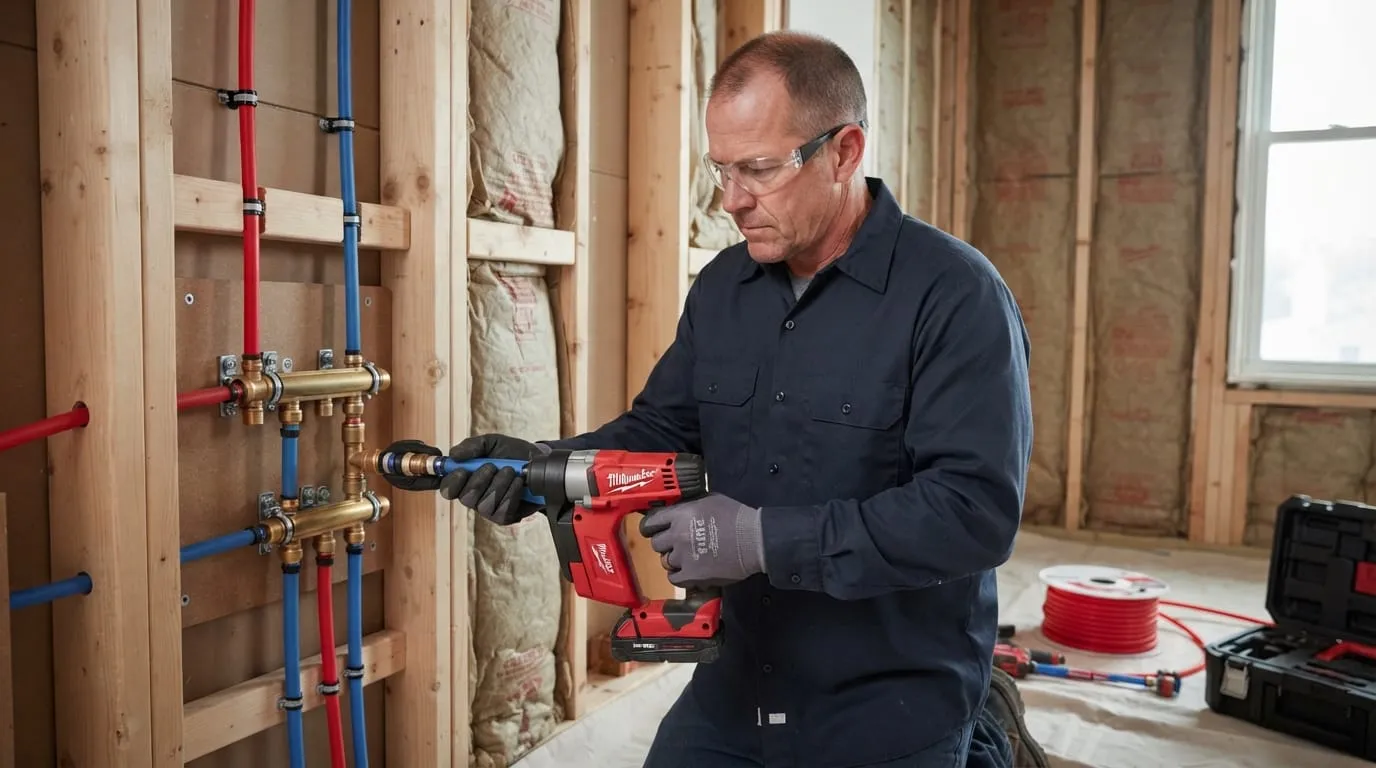
Repiping a property in PEX, which can often be routed through existing cavities, cutting the amount of wall and ceiling that has to be opened.
See what this coversPolybutylene Pipe Replacement
Replacing polybutylene supply pipework, a grey plastic used widely from the late 1970s to the mid 1990s that fails from the inside without warning.
See what this covers
Does this sound familiar?
Problems this covers
- Water pressure that has dropped gradually over years, worst at the furthest fixtures
- Rusty or discoloured water on the first draw of the morning
- A pipe that has burst or split after a freeze
- Repeated pinhole leaks in the same run of copper
- Banging or knocking in the walls when a tap is closed
- Visible corrosion or green staining at pipe joints
Questions
Pipe Services questions
How do I know whether to repair or repipe?
Count the failures. One leak in an otherwise sound system is a repair. A second or third leak in the same system, in different places, is telling you the material has reached the end of its life, and each further repair buys less time than the last. Galvanized steel is the clearest case: it corrodes from the inside along its whole length, so the joints that have not failed yet are simply the ones that have not failed yet.
Why has my water pressure dropped over the years?
Usually galvanized steel corroding from the inside. As the protective zinc coating deteriorates the steel beneath rusts, and the rust narrows the bore, so the fixtures furthest from the source lose out first. Rusty water on the first draw of the morning is the confirming sign. Cleaning does nothing for a pipe in that condition, and the improvement after repiping is routinely larger than owners expect, because the decline was gradual enough not to notice.
What is the difference between copper and PEX?
Copper is rigid, long-lived and tolerates heat well, but it is more expensive to install and can develop pinhole leaks where water chemistry is aggressive. PEX is flexible, cheaper to run, resists freeze damage better because it can expand slightly, and needs far fewer joints because it bends around corners. Most repipes today use PEX for those reasons, though copper still has a place, particularly on exposed runs.
Can a burst pipe be repaired, or does the whole run need replacing?
A single burst in otherwise sound pipe is a repair: cut out the damaged section and splice in new. What matters is why it burst. If it froze because it runs through an unheated space with no insulation, the repair is only half the job and the same length will burst again next winter. If it burst because the material has corroded thin, the rest of that run is in the same condition.

Get it fixed
Pipe Services, handled locally
Call with your ZIP code and what you are seeing. We route you to a licensed plumber in your area who does this work every week.
Free call-routing service. An independent licensed plumber does the work and quotes you directly.
- Licensed and insured
- Answered 24/7
- Price before work