Service category
Leak Detection and Repair
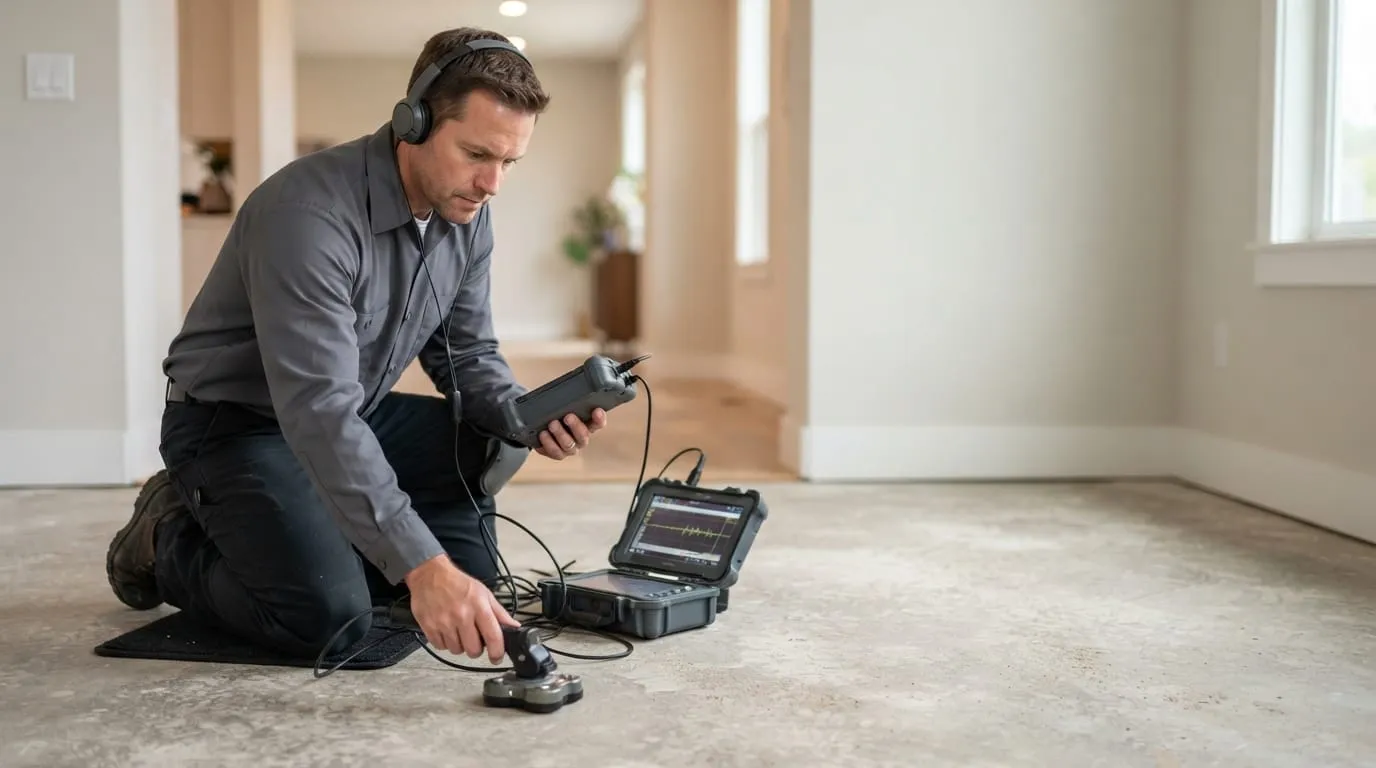
Locating and repairing hidden water leaks under slabs, inside walls and ceilings, underground and at the meter, using acoustic and thermal equipment.
Free call-routing service. An independent licensed plumber does the work and quotes you directly.
- Licensed and insured
- Price agreed before work
- A plumber who works your area
A hidden leak is expensive because of what sits over it, not because of the pipe. Finding it precisely is most of the job: an approximate location in a slab means a much larger hole, and in post-tension construction it means a real risk as well.
Why locating it properly is most of the job
In a house with accessible plumbing, finding a leak roughly is good enough, because opening a wall or a crawl space to look is cheap. Slab construction is not that house.
The sequence matters. Establish that there is a leak, usually at the meter. Determine which line is losing water by isolating and pressure testing. Locate it to a small area acoustically and thermally. Only then decide where, or whether, to open concrete.
Where the slab is post-tensioned, steel cables run through it under high tension, and cutting one during a repair is dangerous and expensive to put right. The cable layout has to be established before any concrete is opened, and the access point chosen around the cables rather than directly over the pipe.
Hot lines fail first
Under-slab hot water lines fail earlier than cold ones, consistently. Heat accelerates corrosion, and the pipe expands and contracts against the concrete every time hot water runs, abrading it at the contact points over years.
That is diagnostically useful. A warm patch on a floor with nothing above it to explain the heat is a hot-side leak until proven otherwise, and so is a water heater or recirculation pump running when the house is asleep. Both are free observations that narrow the search before any equipment comes out of the van.
In this category
Leak Detection and Repair jobs we handle
Leak Detection
Locating hidden water leaks under slabs, inside walls, in yards and at the meter using acoustic, thermal and pressure-testing equipment, then repairing them.
See what this coversWater Leak Repair
Repairing leaks on supply pipework once the source is confirmed, from a weeping joint to a split in a buried line under pressure.
See what this coversSlab Leak Detection
Locating a leak in pipework running beneath a concrete slab foundation, using acoustic and thermal equipment before any concrete is cut.
See what this coversSlab Leak Repair
Repairing a located slab leak by spot repair through the concrete, rerouting the line above the slab, or repiping where the run has failed generally.
See what this coversPipe Leak Repair
Repairing leaks on accessible pipework, in walls, ceilings, crawl spaces and basements, by replacing the failed section rather than clamping it.
See what this coversCeiling Leak Repair
Tracing and repairing water coming through a ceiling, where the stain is rarely above the leak and the source may not be a pipe at all.
See what this coversUnder Sink Leak Repair
Fixing leaks in the cabinet under a sink, where supply valves, flexible connectors, trap joints and the sink seal all fail in different ways.
See what this coversBathroom Leak Repair
Finding and fixing bathroom leaks, including the ones that are not plumbing at all: failed grout, a bad pan, or a toilet seal letting water past.
See what this coversHidden Leak Detection
Finding leaks with no visible water: behind walls, under floors, in buried supply lines, using meter isolation, acoustics and thermal imaging.
See what this covers
Does this sound familiar?
Problems this covers
- A water bill that has risen with no change in how much you use
- The sound of running water with every fixture closed
- A warm or damp patch on a floor with nothing above it to explain it
- Staining on a ceiling or at the base of a wall
- A water heater or recirculation pump cycling when nobody is using water
- Damp ground or unusually green grass in one part of the yard
Questions
Leak Detection and Repair questions
How do I know if I have a hidden leak?
Start at the meter. Turn off every fixture and appliance that uses water, then watch the meter's low-flow indicator. If it is still moving, water is going somewhere. That tells you there is a leak but not where it is, which is the part that needs equipment. Other signs point the same way: an unexplained rise in the bill, running water you can hear but not see, a warm patch on the floor, or damp appearing at a wall base.
What equipment is used to find a leak?
Usually a combination, because no single method works everywhere. Acoustic listening equipment picks up the sound of water escaping under pressure. Thermal imaging finds the temperature difference a hot water leak creates in the surface above it. Pressure testing isolates which line is losing water by shutting sections off and watching what holds. Tracer gas is used where a leak is small or quiet. Using several narrows the position to a small area before anything is opened.
Can a slab leak be fixed without breaking the floor?
Often, and sometimes it is the better option. Rerouting abandons the failed section under the slab and runs a new line through walls, ceilings or the attic to the same fixtures, avoiding the concrete entirely and replacing pipe that was likely to fail again. Where the rest of the system is sound and the leak is a one-off, a spot repair through a small opening is reasonable. Where a house has already had a slab leak or two, rerouting usually costs less over any sensible horizon.
My leaks keep coming back in different places. Why?
That pattern points at pressure rather than at any individual pipe. If a pressure reducing valve has failed or was never fitted, static pressure can run far above what domestic fittings, connectors and appliance hoses are built for. The leaks are the symptom. Measuring static pressure at a hose bib takes a moment, and until it is brought back into range, fixing each joint in turn just moves the failure to the next weakest point.

Get it fixed
Leak Detection and Repair, handled locally
Call with your ZIP code and what you are seeing. We route you to a licensed plumber in your area who does this work every week.
Free call-routing service. An independent licensed plumber does the work and quotes you directly.
- Licensed and insured
- Answered 24/7
- Price before work