Service category
Faucet and Sink Services
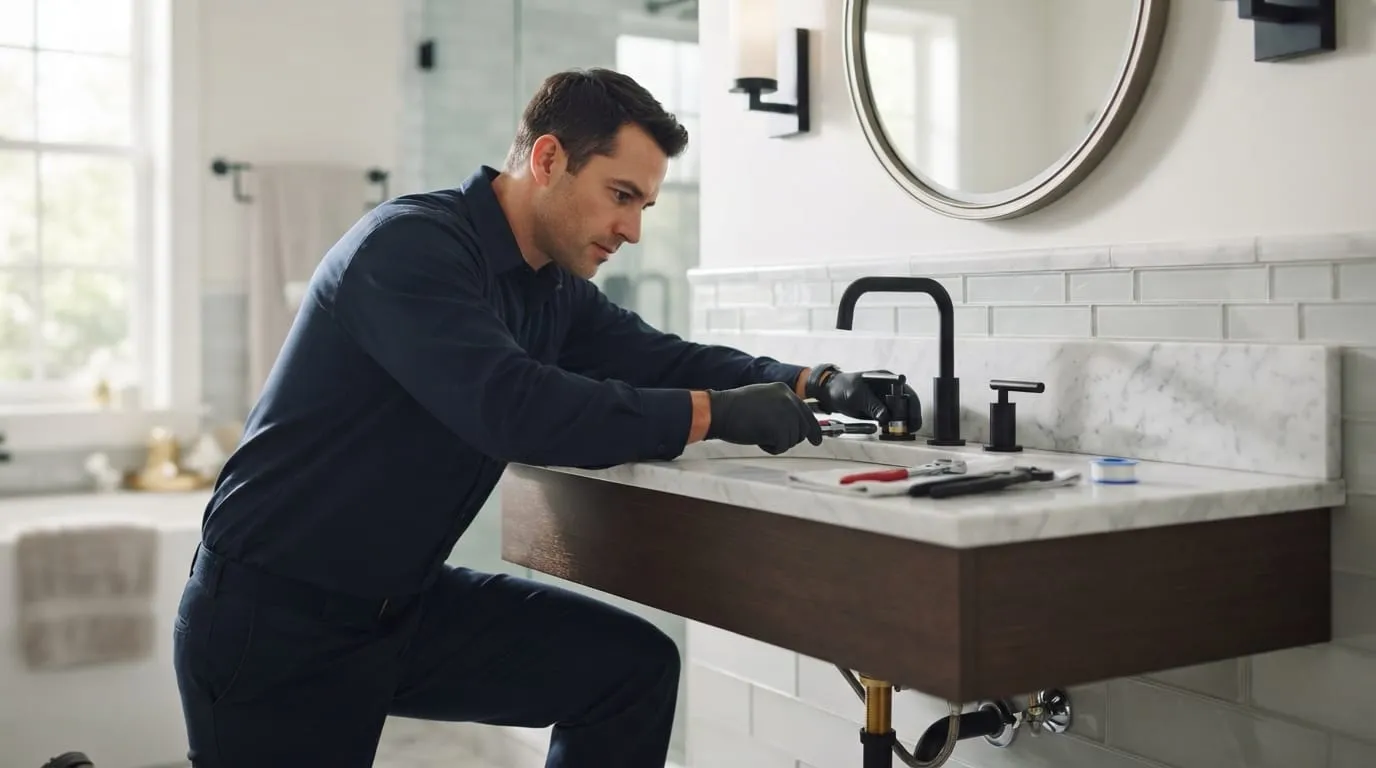
Repair, replacement and installation of kitchen and bathroom faucets and sinks, including drips, weak flow, leaking traps and worn cartridges.
Free call-routing service. An independent licensed plumber does the work and quotes you directly.
- Licensed and insured
- Price agreed before work
- A plumber who works your area
Most faucet faults are a worn cartridge, a perished washer or a blocked aerator, and all three are quick to put right. The ones worth attention are leaks under the sink, where water has been reaching the cabinet base for longer than anyone realises.
The aerator first
When one fixture has weak flow and the rest of the house is fine, the problem is at that fixture, and the cheapest thing to check is the aerator: the small screen at the tip of the spout.
It exists to mix air into the stream, and it catches everything that comes down the line, sediment, grit after work on the main, and mineral scale in hard-water areas. It unscrews by hand or with pliers, and soaking it clears most of what collects. This is worth doing before anyone is called out.
If that makes no difference, the next candidates are the isolating valve under the sink not fully open, a blocked or failing cartridge, or a flexible supply hose that has kinked.
Under the sink is where the damage happens
The cabinet under a sink is the part of a house most likely to be quietly rotting, because a small leak there is out of sight behind whatever is stored in front of it.
Telling the three causes apart is straightforward. Dry everything, then watch. Wet only when the sink drains points at the trap or a waste connection. Wet continuously points at the supply side, an isolating valve or a flexible hose, and that is the one under pressure. Damp rather than running, worst in humid weather, is condensation on a cold pipe.
Flexible supply hoses deserve particular attention, because they fail suddenly rather than gradually and they are connected to a line under full pressure.
In this category
Faucet and Sink Services jobs we handle
Faucet Repair
Repair and replacement of dripping, leaking, low-pressure and stiff kitchen, bathroom, tub, shower and outdoor faucets, including cartridge and valve work.
See what this coversFaucet Installation
Fitting new taps, including the hole configuration, the shutoff valves underneath and the supply connectors that decide whether it stays leak-free.
See what this coversFaucet Replacement
Replacing a worn or failed tap, including removing one that has corroded into place and dealing with what is found underneath.
See what this coversSink Installation
Fitting kitchen and bathroom sinks, including the cutout, the mounting method and the waste and trap arrangement underneath.
See what this coversSink Repair
Repairing sinks and their waste fittings, from a failed flange seal to a cracked trap or a pop-up waste that no longer holds water.
See what this coversKitchen Faucet Repair
Repairing kitchen taps, including pull-out sprays that will not retract, weak flow from a blocked aerator, and leaks from the base rather than the spout.
See what this coversBathroom Faucet Repair
Repairing basin taps, including constant drips, pop-up wastes that will not seal and the corrosion that builds under a tap in a humid room.
See what this covers
Does this sound familiar?
Problems this covers
- A tap that drips continuously even when fully closed
- Weak flow from one fixture while the rest of the house is fine
- Water pooling in the cabinet under a sink
- A faucet handle that is stiff, loose or turns without effect
- Cold water only, or hot and cold reversed after work on the system
- A sink that drains slowly or gurgles
Questions
Faucet and Sink Services questions
Why does my tap keep dripping after I replace the washer?
Because the washer is usually not the whole story. In a compression tap, the seat that the washer closes against wears too, and a new washer pressed against a pitted seat will not seal for long. The seat can often be reground or replaced. In a modern mixer the equivalent part is the cartridge, and replacing the cartridge rather than trying to service it is normally the right repair.
Why is the flow weak from just one tap?
Start with the aerator, the small screen at the tip of the spout. It catches sediment and mineral scale, and in hard-water areas it blocks steadily until flow drops noticeably. It unscrews by hand or with pliers and can be soaked clean. If clearing the aerator makes no difference, the next candidates are the isolating valve under the sink not fully open, a blocked cartridge, or a kinked flexible supply hose.
There is water in the cabinet under my sink. Where is it from?
Three usual sources, and they are easy to tell apart with a dry paper towel. A leaking trap or waste connection only wets the cabinet when the sink drains. A supply leak, at the isolating valve or the flexible hose, is wet continuously and often under pressure. Condensation on a cold pipe is damp rather than running and is worst in humid weather. Whichever it is, the cabinet base has been absorbing it for a while.
Is it worth repairing a faucet or should I replace it?
Cartridges, washers, seats, aerators and supply hoses are all inexpensive and worth replacing on a faucet you like. Replacement makes more sense when the body itself is corroded, when the finish has failed, when parts are no longer available for an old model, or when the same tap has needed several repairs. A plumber should be able to tell you whether the part is still obtainable before you decide.

Get it fixed
Faucet and Sink Services, handled locally
Call with your ZIP code and what you are seeing. We route you to a licensed plumber in your area who does this work every week.
Free call-routing service. An independent licensed plumber does the work and quotes you directly.
- Licensed and insured
- Answered 24/7
- Price before work