Service
Bathroom Faucet Repair
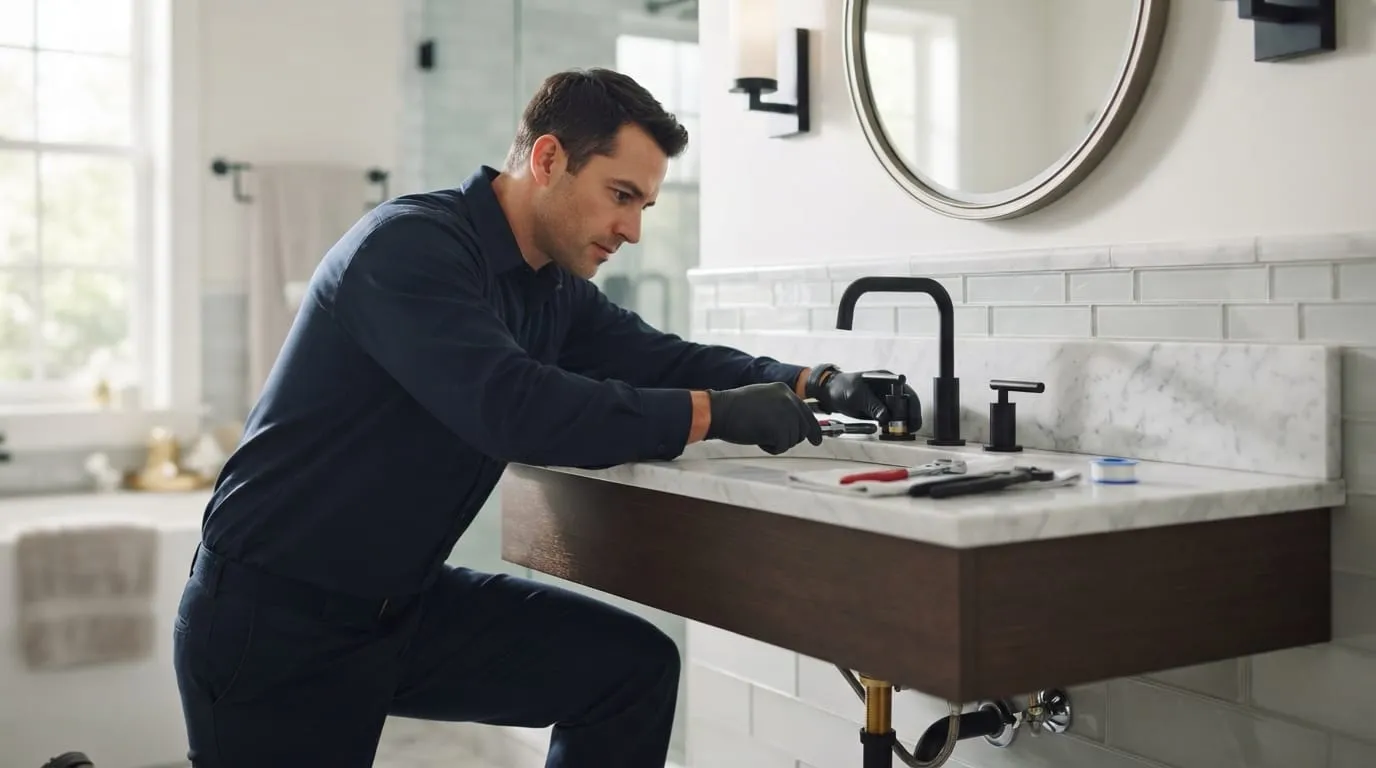
Repairing basin taps, including constant drips, pop-up wastes that will not seal and the corrosion that builds under a tap in a humid room.
Free call-routing service. An independent licensed plumber does the work and quotes you directly.
- Licensed and insured
- Price agreed before work
- A plumber who works your area
The washer is only half the seal
The most common frustration with a dripping tap is a repair that does not stop the drip.
A washer seals by pressing against a machined surface inside the tap body called the seat. Over years, mineral deposits and grit passing through the tap pit that surface until it is no longer flat.
A new washer against a pitted seat still drips, no matter how firmly the tap is closed. The washer was never the whole problem.
The seat can be dressed with a seat cutter, or replaced on taps that allow it. That is the step that actually stops it, and it is why a tap that drips again a week after a washer change is not a failed repair so much as an incomplete one.
Pop-ups are almost always adjustment
A basin that will not hold water rarely needs a new waste.
The plug is operated by a rod at the back of the tap, which connects to a horizontal pivot arm under the basin through a clip. That clip slips over time, and when it does the plug no longer travels far enough down to seal.
Readjusting it takes a couple of minutes and no parts.
Only when the seal on the plug itself has perished, or the pivot has corroded solid, is anything actually replaced, and that is the less common case by a distance.
Does this sound familiar?
Problems this service solves
- A basin tap that drips continuously
- A pop-up waste that no longer holds water
- Handles that have become stiff or will not shut off fully
- Corrosion around the base of a tap in a humid bathroom
- Weak flow from a basin tap only
Signs you need bathroom faucet repair
If more than one of these is true, the problem is usually past the point a plunger or a store-bought cleaner will fix.
- The tap drips after being turned off firmly
- The plug will not hold a full basin
- A handle needs force to close
- There is green or white crust around the base
What to expect
How the visit works
Replace the cartridge or washer
A steady drip is a worn cartridge on a mixer or a washer on a traditional tap, and both are inexpensive parts.
Check the seat
A new washer against a pitted seat still drips. The seat gets inspected and dressed or replaced rather than the washer changed twice.
Adjust the pop-up linkage
A pop-up that will not seal is usually the rod behind the basin having slipped out of adjustment, not a failed waste.
Look at the corrosion
Crust around a tap base means water has been sitting there, which is worth tracing rather than cleaning off.
What's included
What you get on every job, whoever we send.
- Seats checked, not just washers replaced
- Pop-up linkages adjusted before parts are replaced
- Corrosion treated as evidence of a leak, not just staining
- Cheap parts tried before an expensive replacement
Questions
Bathroom Faucet Repair questions
I replaced the washer and it still drips. What now?
The seat. A washer seals by pressing against a machined surface inside the tap body, and over years that surface becomes pitted by mineral deposits and by grit in the water. A brand new washer cannot seal against an uneven face, so the drip continues and it looks like the repair failed. The seat can often be dressed with a seat cutter, or replaced where the tap allows it. It is the standard second step and it is what actually stops the drip.
My basin will not hold water. Is the plug worn?
Usually it is the adjustment rather than the plug. A pop-up waste is operated by a rod behind the basin connected to a horizontal pivot, and if the clip on that rod slips, the plug no longer travels far enough to seal. Readjusting it takes a couple of minutes with your head under the basin. Only if the seal on the plug itself has perished, or the pivot has corroded, does anything need replacing.
Why is there crust around the base of my tap?
Because water has been sitting there long enough to leave mineral deposits, and the question worth asking is where it came from. Splashing accounts for some of it. Persistent crust usually means a slow weep from the tap base or from a connection underneath, and it has been going on for a while. Cleaning it off removes the evidence without fixing anything, so it is worth having a look underneath first.
Related services
Faucet Repair
Repair and replacement of dripping, leaking, low-pressure and stiff kitchen, bathroom, tub, shower and outdoor faucets, including cartridge and valve work.
See what this coversSink Repair
Repairing sinks and their waste fittings, from a failed flange seal to a cracked trap or a pop-up waste that no longer holds water.
See what this coversFaucet Replacement
Replacing a worn or failed tap, including removing one that has corroded into place and dealing with what is found underneath.
See what this coversWater Heater Repair
Diagnosis and repair of gas, electric and tankless water heaters, including no-hot-water calls, leaks, pilot problems and sediment flushing.
See what this covers

Get it fixed
Bathroom Faucet Repair, handled locally
Call with your ZIP code and what you are seeing. We route you to a licensed plumber in your area who does bathroom faucet repair every week.
Free call-routing service. An independent licensed plumber does the work and quotes you directly.
- Licensed and insured
- Answered 24/7
- Price before work