Service
Sink Repair
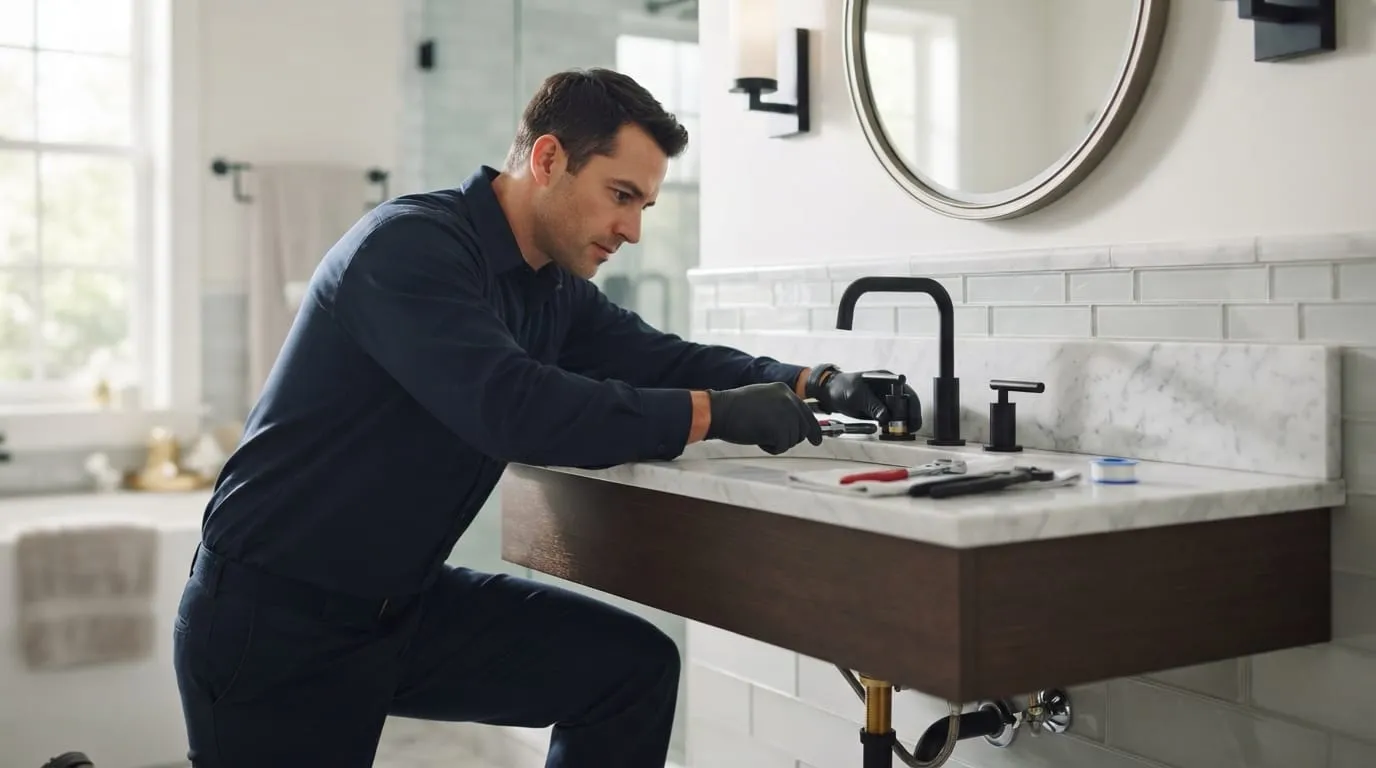
Repairing sinks and their waste fittings, from a failed flange seal to a cracked trap or a pop-up waste that no longer holds water.
Free call-routing service. An independent licensed plumber does the work and quotes you directly.
- Licensed and insured
- Price agreed before work
- A plumber who works your area
Fill it before you drain it
Two tests, thirty seconds apart, separate the two kinds of sink leak.
Run the tap with the plug out. Water passes straight down the centre of the waste and through the trap. A leak now is at a joint: the tailpiece, a slip nut, the trap itself.
Fill the bowl and leave it. Now there is standing water pressing against the flange seal where the waste fitting passes through the sink. A leak that appears only now, with nothing draining, is that seal.
The second one catches people out, because there is no water moving and no obvious reason for anything to leak.
Sealant does not stack
The most common failed repair on a sink is a fresh bead of sealant applied over an old one.
Sealant bonds to a clean, dry surface. Applied over an existing seal that has failed, it bonds to old sealant, grease and moisture, none of which are going anywhere. The result looks finished and water carries on passing behind it.
Doing it properly means taking the fitting out, cleaning both faces back to bare material, and rebedding it.
It is perhaps twenty minutes longer and it is the difference between a repair and a delay.
Does this sound familiar?
Problems this service solves
- Water leaking around the waste fitting in the bowl
- A cracked or split trap under the sink
- A pop-up waste that will not hold water
- A sink that drains slowly through its own fitting
- Loose or corroded waste connections
Signs you need sink repair
If more than one of these is true, the problem is usually past the point a plunger or a store-bought cleaner will fix.
- Water appears under the sink when the bowl is drained
- The plug will not hold water in the bowl
- There is a visible crack in the trap or tailpiece
- The waste fitting moves when you push on it
What to expect
How the visit works
Establish whether it leaks under fill or under flow
A leak on draining points at joints. A leak that appears when the bowl is simply full points at the flange seal in the bowl itself.
Reseal the flange properly
The waste fitting is removed, the old sealant cleaned off both faces, and it is rebedded. Adding sealant over the top of a failed seal does not work.
Replace cracked components
Split traps, cracked tailpieces and over-tightened plastic nuts are replaced rather than wrapped, because a wrapped crack is a leak with a delay.
Adjust or rebuild the pop-up
A pop-up that will not seal is usually a linkage adjustment or a perished seal rather than a whole new waste.
What's included
What you get on every job, whoever we send.
- Fill and flow tested separately to find the source
- Flange properly stripped and rebedded, not sealed over
- Cracked parts replaced rather than patched
- Pop-up mechanisms adjusted before anything is replaced
Questions
Sink Repair questions
Water only appears when the bowl is full. What is that?
The flange seal, where the waste fitting passes through the sink itself. Under normal running, water goes straight down the middle and past it. With the bowl full, there is standing water sitting against that seal with pressure behind it, so a failed seal shows up. It is a distinctive symptom and it tells you the leak is at the sink, not at any of the joints below it.
Can I just put more sealant on a leaking waste fitting?
It rarely works. Sealant needs to bond to a clean, dry surface, and adding a bead over an existing failed seal means it is bonding to old sealant and to whatever water and grease are underneath. It looks sealed and water continues to pass behind it. The fitting has to come out, both faces cleaned back properly, and the seal remade. It is a slightly longer job that actually holds.
My pop-up plug will not hold water. Does it need replacing?
Usually not. Most pop-up wastes that stop sealing have either lost their adjustment, where the linkage rod behind the sink has slipped so the plug no longer pulls down fully, or have a perished seal on the plug itself. Both are quick fixes. Replacing the whole waste assembly is the answer when the body is corroded or the linkage has broken, which is much less common.
Related services
Under Sink Leak Repair
Fixing leaks in the cabinet under a sink, where supply valves, flexible connectors, trap joints and the sink seal all fail in different ways.
See what this coversSink Installation
Fitting kitchen and bathroom sinks, including the cutout, the mounting method and the waste and trap arrangement underneath.
See what this coversFaucet Repair
Repair and replacement of dripping, leaking, low-pressure and stiff kitchen, bathroom, tub, shower and outdoor faucets, including cartridge and valve work.
See what this coversWater Heater Repair
Diagnosis and repair of gas, electric and tankless water heaters, including no-hot-water calls, leaks, pilot problems and sediment flushing.
See what this covers

Get it fixed
Sink Repair, handled locally
Call with your ZIP code and what you are seeing. We route you to a licensed plumber in your area who does sink repair every week.
Free call-routing service. An independent licensed plumber does the work and quotes you directly.
- Licensed and insured
- Answered 24/7
- Price before work