Service
Water Leak Repair
Repairing leaks on supply pipework once the source is confirmed, from a weeping joint to a split in a buried line under pressure.
Free call-routing service. An independent licensed plumber does the work and quotes you directly.
- Licensed and insured
- Price agreed before work
- A plumber who works your area
The meter answers the first question
Before anyone opens a wall, it is worth establishing that there is genuinely a leak.
Turn off everything that uses water. Every tap, the dishwasher, the washing machine, the ice maker, the irrigation. Read the meter and write down the numbers. Leave it an hour and read it again.
If it has moved, water is leaving the system on your side of the meter and the question becomes where. If it has not, the damp you are seeing has another source, and that is worth knowing before spending money on leak detection.
One hole rarely means one problem
Pinhole leaks in copper are the case where the repair and the diagnosis diverge.
A pinhole is not damage from outside. It is the pipe wall being eaten through from the inside, either by water chemistry or by flow velocity in a run that was sized or routed badly.
Whichever it is, the cause applies to the whole run, not to the inch that failed first. So the useful question after fixing one is how many others are close behind, and the answer decides whether you are looking at a repair or at repiping a section. That conversation is better had at the first pinhole than at the third.
Does this sound familiar?
Problems this service solves
- A water bill that has climbed with no change in use
- Damp patches on walls, ceilings or floors
- The meter turning with every tap closed
- A pinhole leak in copper pipework
- A joint that has begun to weep
Signs you need water leak repair
If more than one of these is true, the problem is usually past the point a plunger or a store-bought cleaner will fix.
- The meter moves when nothing is running
- Water pressure has dropped across the property
- There is a persistent damp smell in one area
- Staining that spreads slowly rather than appearing at once
What to expect
How the visit works
Confirm the leak exists
The meter test settles it. Everything off, meter read, wait, read again. A moving meter means water is escaping somewhere on your side.
Find it before opening anything
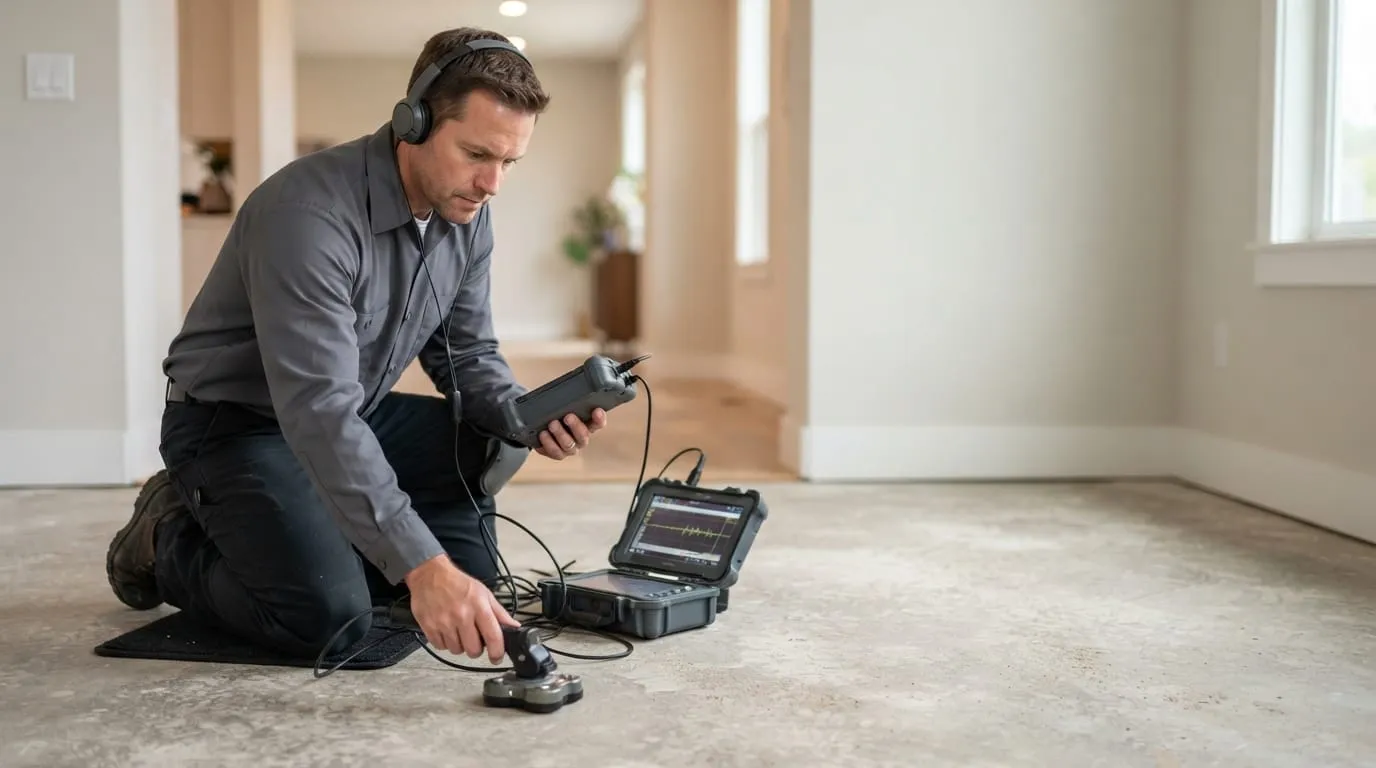
Acoustic listening, pressure isolation and thermal imaging narrow the position, so the repair opens one place instead of several.
Repair the pipe properly
A section of pipe is cut out and replaced rather than clamped, because a clamp on a corroded line is a repair with an expiry date.
Check for a pattern
One pinhole in copper often means water chemistry or velocity is attacking the whole run, so the rest is assessed rather than ignored.
What's included
What you get on every job, whoever we send.
- Located before anything is opened up
- Failed pipe replaced rather than clamped
- The wider run checked for the same cause
- Damage kept to one access point where possible
Questions
Water Leak Repair questions
How do I confirm I have a leak before calling?
Use the meter. Turn off every tap and appliance that uses water, including ice makers and irrigation, then read the meter and note the figures. Come back in an hour without using anything. If the reading has moved, water is leaving the system somewhere on your side of the meter. It is a five-minute test that turns a suspicion into a fact, and it is useful information to have when you call.
I have one pinhole in a copper pipe. Is patching it enough?
As an immediate stop, yes. As a repair, usually not, because pinholes rarely happen in isolation. They are caused by the water chemistry or by flow velocity attacking the pipe wall from inside, and that condition applies to the whole run rather than to the one spot that failed first. If a second pinhole appears within months, the question stops being about repairs and becomes about repiping that section.
Where do leaks usually hide?
In the places with the least visibility and the most movement. Joints, because they are where the pipe is mechanically stressed. Pipes buried in slabs, where soil movement and abrasion work on them for decades. Runs inside walls near fixtures, where the pipe was cut and joined during construction. And connections to appliances, where a flexible hose ages quietly under a sink until it fails.
Related services
Leak Detection
Locating hidden water leaks under slabs, inside walls, in yards and at the meter using acoustic, thermal and pressure-testing equipment, then repairing them.
See what this coversPipe Repair
Repair and replacement of burst, leaking, frozen, corroded or noisy water pipes, from a single fitting to a whole-house repipe in copper or PEX.
See what this covers- 24/7
Emergency Leak Repair
Urgent repair of active leaks that are running now, including finding the source when water is appearing somewhere other than where the pipe failed.
See what this covers Water Heater Repair
Diagnosis and repair of gas, electric and tankless water heaters, including no-hot-water calls, leaks, pilot problems and sediment flushing.
See what this covers

Get it fixed
Water Leak Repair, handled locally
Call with your ZIP code and what you are seeing. We route you to a licensed plumber in your area who does water leak repair every week.
Free call-routing service. An independent licensed plumber does the work and quotes you directly.
- Licensed and insured
- Answered 24/7
- Price before work