24/7 service
Emergency Leak Repair
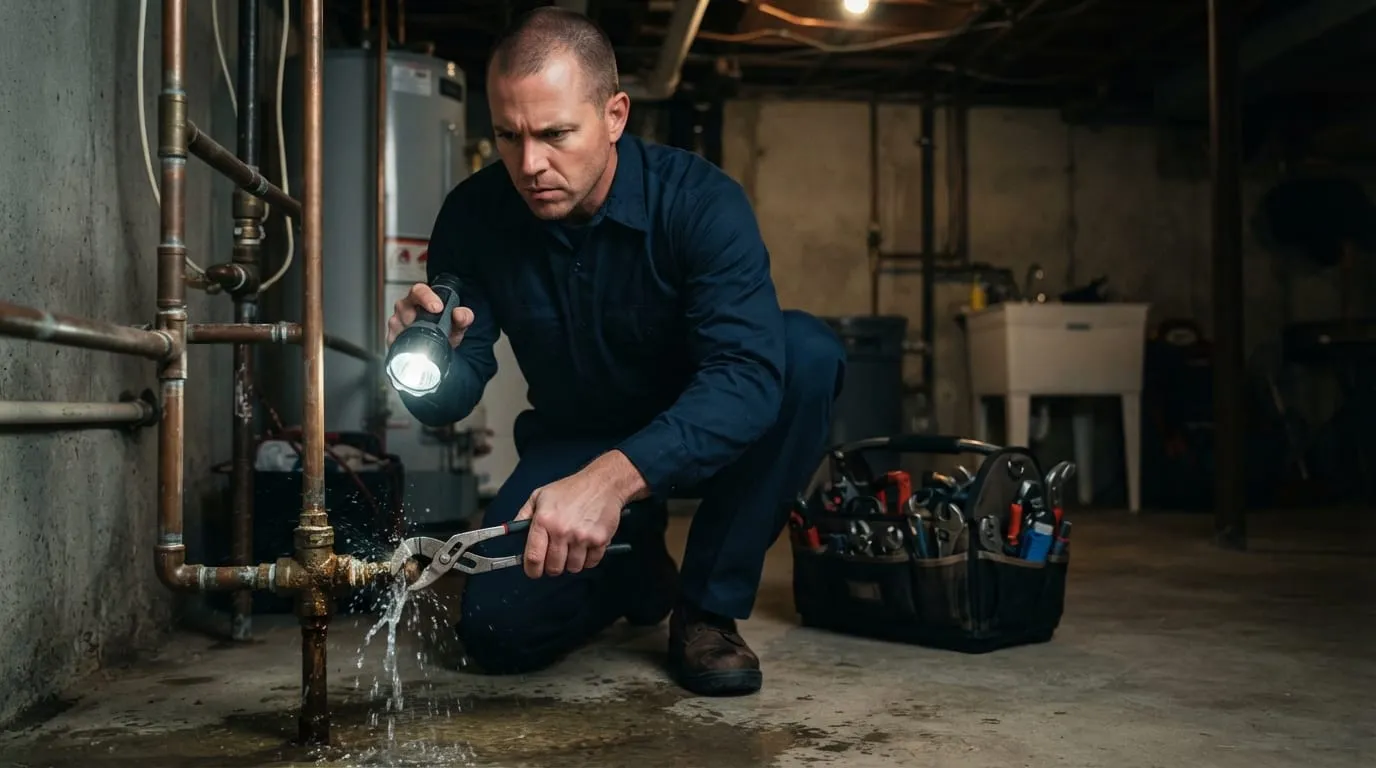
Urgent repair of active leaks that are running now, including finding the source when water is appearing somewhere other than where the pipe failed.
Free call-routing service. An independent licensed plumber does the work and quotes you directly.
- Licensed and insured
- Answered 24 hours a day
- A plumber who works your area
Where water appears is not where it leaves the pipe
This is the single most useful thing to know about an active leak.
Water runs along joists, follows pipe runs, tracks down the back of plasterboard and emerges wherever it first finds a way through. The stain on a ceiling can be several metres from the failure, and on a different level.
Which is why the first job is locating the source rather than opening up the ceiling at the drip. Guessing wrong costs an extra hole and the time to make it.
A bulging ceiling is worth managing deliberately
If a ceiling is sagging, water is pooling above the plaster and the weight is increasing.
Letting it fail on its own means the whole section comes down at once, taking more of the ceiling with it and putting the water everywhere. Piercing it deliberately at the lowest point of the bulge, with something small and a container underneath, drains it in a controlled way and usually saves the surrounding area.
Stay away from light fittings, and if one is near the water, cut power to that circuit before doing anything at all.
Does this sound familiar?
Problems this service solves
- Water running actively that you cannot trace to a fixture
- A ceiling that is bulging or dripping
- Water appearing at the base of a wall or through a floor
- A leak that started after other work in the building
- A joint or connector that is spraying under pressure
- A leak that has been slow for weeks and has suddenly worsened
Signs you need emergency leak repair
If more than one of these is true, the problem is usually past the point a plunger or a store-bought cleaner will fix.
- Water is arriving faster than it can be mopped or contained
- A ceiling is stained, sagging or dripping
- The meter is moving quickly with all fixtures closed
- Damp is spreading visibly across a surface
- A previously minor leak has changed character
What to expect
How the visit works
Contain first
Water is stopped or isolated to the smallest section possible, which sometimes means the main and sometimes just one branch, so the rest of the property keeps working.
Find where it is actually coming from
Water travels along joists and behind surfaces, so the place it appears is often not the place it leaves the pipe. The source is located before anything is opened up.
Repair the failure
The failed joint, connector or section is replaced. Where the surrounding material is compromised, that is dealt with rather than sealed over.
Check what else is wet
An active leak has been soaking structure for as long as it has been running. You are told what is wet and what needs drying, because that is where the expensive damage lives.
What's included
What you get on every job, whoever we send.
- Isolation to the smallest possible section, so the property stays usable
- The real source found rather than the place water appeared
- Repair rather than a temporary seal over a failing component
- A clear picture of what got wet and what needs drying out
Questions
Emergency Leak Repair questions
Water is coming through my ceiling. What do I do first?
Turn off the main and put a container under it. If the ceiling is bulging, that is water pooling above the plaster, and it is usually better to pierce it deliberately at the lowest point of the bulge with something small so it drains in a controlled way, rather than letting the whole section give way at once. Keep clear of electrical fittings, and if a light fitting is anywhere near the water, cut power to that circuit.
The water is appearing in one room but I think the leak is elsewhere. Is that possible?
Very. Water runs along joists, follows pipe runs and travels down the back of surfaces before it finds a place to emerge, so the visible damage can be a surprising distance from the failure. That is why the repair starts with locating the source rather than opening up the ceiling where the drip is. Guessing wrong means two holes instead of one.
Can you stop the leak without turning off water to the whole house?
Usually, yes. Most properties can be isolated in sections, at a branch valve or at the fixture, which means the leak stops while the rest of the house keeps working. It is not always possible in older systems where isolating valves were never fitted, and if that is the case it is worth adding them afterwards, because it turns every future repair into a smaller disruption.
The leak has been slow for weeks and just got worse. Does that matter?
It matters for what got damaged rather than for the repair. A leak that has been running slowly has been soaking whatever is around it the whole time, so the structure may be in worse condition than the sudden change suggests. Worth having the surrounding area assessed rather than just the pipe, because the drying-out is often the larger part of the job.
Related services
Leak Detection
Locating hidden water leaks under slabs, inside walls, in yards and at the meter using acoustic, thermal and pressure-testing equipment, then repairing them.
See what this covers- 24/7
Burst Pipe Repair
Emergency repair of split, cracked and burst water pipes, including freeze damage, with the cause addressed so the same run does not fail again.
See what this covers Water Leak Repair
Repairing leaks on supply pipework once the source is confirmed, from a weeping joint to a split in a buried line under pressure.
See what this coversWater Heater Repair
Diagnosis and repair of gas, electric and tankless water heaters, including no-hot-water calls, leaks, pilot problems and sediment flushing.
See what this covers

Get it fixed
Emergency Leak Repair, handled locally
Call with your ZIP code and what you are seeing. We route you to a licensed plumber in your area who does emergency leak repair every week.
Free call-routing service. An independent licensed plumber does the work and quotes you directly.
- Licensed and insured
- Answered 24/7
- Price before work