Service
Battery Backup Sump Pump
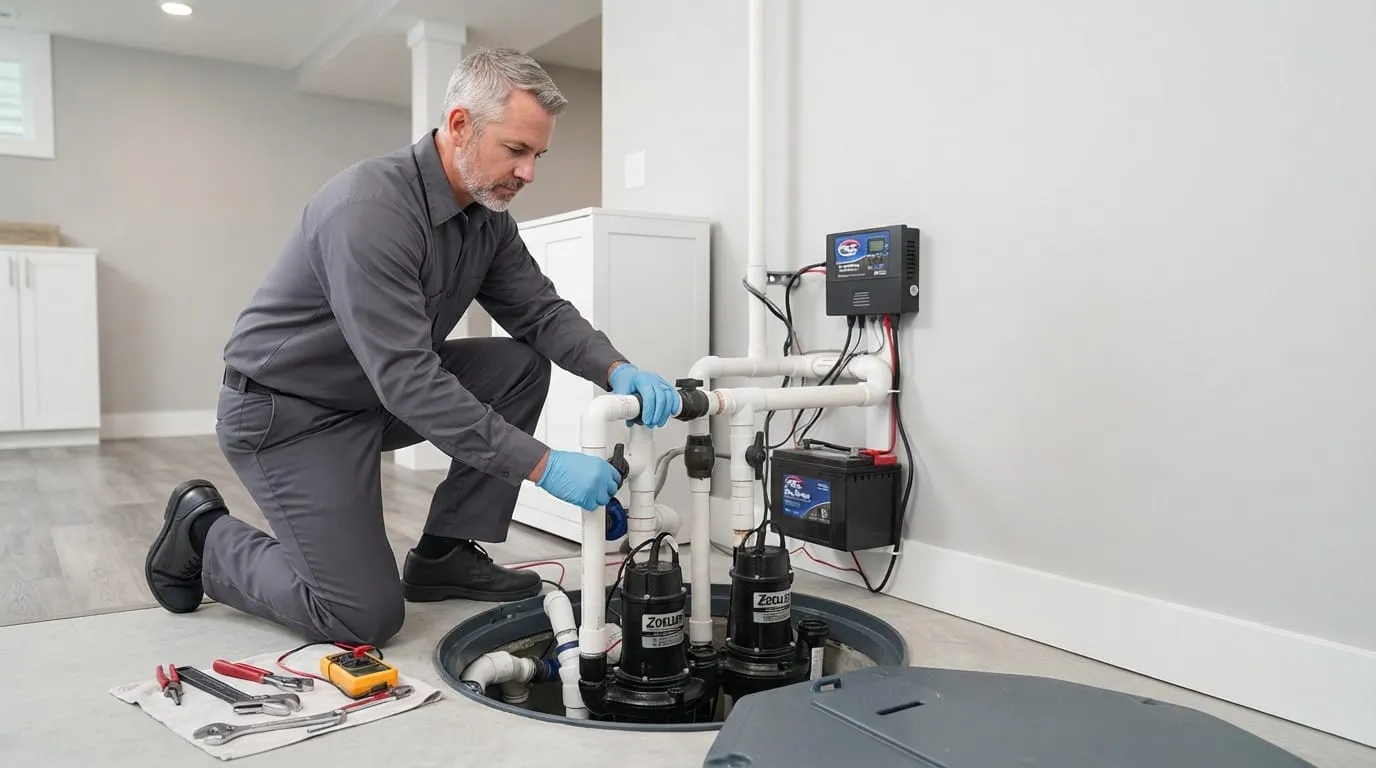
Fitting a backup pump that runs when the power fails or the primary cannot cope, since the storms that flood basements also cut the electricity.
Free call-routing service. An independent licensed plumber does the work and quotes you directly.
- Licensed and insured
- Price agreed before work
- A plumber who works your area
The failure modes overlap
The case for a backup pump rests on one uncomfortable coincidence.
Basements flood during sustained heavy rain. Sustained heavy rain brings down power lines. So the conditions that make a sump pump essential are the same conditions that switch it off.
A single mains-powered pump is protection that is statistically most likely to be unavailable at the moment it is needed.
Add the second risk, that any pump can simply fail, and a single unit protecting a finished basement is a single point of failure with predictable timing.
Two ways to do it
Battery backup. A second pump with its own battery and charger. It works anywhere, regardless of water supply, and it will run any pump. The trade-offs are maintenance and duration: the battery needs testing and replacing every few years, and its capacity sets a limit on how long the pump can run during a long outage.
Water-powered backup. Uses mains water pressure to drive an ejector that lifts water out of the pit. No battery, no electricity, and it runs indefinitely. The trade-offs are that it needs good municipal water pressure, it is not an option on a well, and it uses a substantial volume of water while running.
Which suits depends on your supply and on how long power tends to be out where you live. Both are set with their float above the primary, so they sit idle until the primary cannot cope.
Does this sound familiar?
Problems this service solves
- A finished basement protected by a single pump
- Power cuts during the storms that cause flooding
- A primary pump that cannot keep up in heavy rain
- No protection if the primary pump fails
- A property where a flood would be expensive
Signs you need battery backup sump pump
If more than one of these is true, the problem is usually past the point a plunger or a store-bought cleaner will fix.
- There is only one pump in the pit
- Power cuts are common during heavy weather
- The basement is finished or holds valuable contents
- The primary pump struggles during long storms
What to expect
How the visit works
Assess what the backup is for
Power failure and primary failure are different risks. A battery backup covers both; a water-powered one covers power loss without a battery to maintain.
Set the switch height
The backup float is set above the primary, so it only runs when the primary cannot cope or has stopped.
Install the battery and charger
The battery is sited where it can be reached and maintained, with a charger that keeps it ready rather than one that only charges after use.
Test both pumps
The pit is filled with the primary disabled, so the backup is proved to start and clear the pit on its own.
What's included
What you get on every job, whoever we send.
- Backup float set above the primary, so it stays in reserve
- Battery sited where it can actually be maintained
- Proved by testing with the primary disabled
- An honest comparison of battery and water-powered options
Questions
Battery Backup Sump Pump questions
Do I really need a backup pump?
It depends on what a flooded basement would cost you. The argument for one is simple: the heavy, prolonged storms that overwhelm a sump system are the same weather events that bring down power lines. A single pump on mains power is protection that is most likely to be absent exactly when it is needed. If the basement is finished, or holds anything that matters, the case is straightforward.
Battery or water-powered backup?
Battery backups run any pump and work anywhere, but the battery needs maintaining and replacing every few years, and its capacity limits how long it can run. Water-powered backups use mains water pressure to drive an ejector and can run indefinitely with no battery, but they need adequate municipal water pressure, they use a lot of water while running, and they are not suitable on a well. Which fits depends on your supply and how long outages typically last.
How is a backup pump set up in the pit?
With its float switch set higher than the primary pump's. In normal operation the primary starts, clears the pit, and the water never reaches the backup's trigger level, so the backup sits idle. It only starts when the water keeps rising, which means either the primary has failed, has lost power, or cannot keep up with the inflow. That is exactly when you want it.
Related services
Sump Pump Installation
Installing a sump pump and pit, including the discharge route, the check valve and the question of what happens when the power fails.
See what this coversSump Pump Replacement
Replacing a failed or ageing sump pump, sized for how much water the pit actually takes rather than matching whatever was there before.
See what this coversSump Pump Repair
Repairing sump pumps that run constantly, will not start, or run without clearing the pit, before the next storm rather than during it.
See what this coversWater Heater Repair
Diagnosis and repair of gas, electric and tankless water heaters, including no-hot-water calls, leaks, pilot problems and sediment flushing.
See what this covers

Get it fixed
Battery Backup Sump Pump, handled locally
Call with your ZIP code and what you are seeing. We route you to a licensed plumber in your area who does battery backup sump pump every week.
Free call-routing service. An independent licensed plumber does the work and quotes you directly.
- Licensed and insured
- Answered 24/7
- Price before work