Los Angeles, California
Leak Detection in Los Angeles, CA
A leak under a Los Angeles slab is rarely expensive because of the pipe. It is expensive because of the concrete over it, and in homes built between roughly 1960 and 1990 that concrete is often post-tensioned, which means it cannot simply be cut open wherever seems convenient. Los Angeles leak detection plumbers in our network find the leak precisely first, then tell you what reaching it actually involves.
Free call-routing service. An independent licensed plumber does the work and quotes you directly.
Local problems
Leak Detection problems we see in Los Angeles
Slab leaks under post-tension foundations
A great deal of housing built here between about 1960 and 1990 sits on post-tension slabs, where steel cables run through the concrete under tension. Cutting one during a repair is a serious and costly mistake, so the leak has to be located accurately and the cables mapped before any concrete is opened.
Hot water lines failing before cold
Under-slab hot lines fail earlier and more often than cold, because heat accelerates corrosion and the pipe expands and contracts against the concrete every time hot water runs. A warm patch on the floor, or a water heater that runs constantly, usually points at the hot side.
Pressure damage in the hillside neighbourhoods
In the canyon and hillside areas, static pressure can reach levels no fixture is built for when the pressure reducing valve has failed or was never fitted. High pressure produces leaks at joints and fittings throughout the house, so the leak is a symptom and the valve is the cause.
Galvanized supply leaking after decades of corrosion
The pre-war housing across the older neighbourhoods still runs galvanized steel supply that has been corroding inward for the best part of a century. It fails as pinholes at threaded joints and in wall cavities, and one repair is usually followed by another.
Leaks that only show as a bill
Under a slab, in a wall or below a hillside driveway, a leak can run for months with no visible water. An unexplained rise in the bill, a meter that moves with everything off, or a hot spot on the floor is often the only evidence before damage appears.
Why locating it properly is most of the job
In a house with accessible plumbing, finding a leak roughly is good enough, because opening a wall or a crawl space to look is cheap. Los Angeles is often not that house.
A large share of the city’s housing from around 1960 to 1990 sits on post-tension slabs, where steel cables run through the concrete under high tension to hold it together. Those slabs are strong and they resist the ground movement this region delivers, but they cannot be cut wherever you like. Severing a tensioned cable during a repair is dangerous while it is happening and expensive afterwards.
So the sequence matters. Establish that there is a leak, usually at the meter. Determine which line is losing water by isolating and pressure testing. Locate it to a small area with acoustic equipment and thermal imaging. Establish where the cables run. Only then decide where, or whether, to open concrete.
An approximate location in a conventional slab means a larger hole. An approximate location in a post-tension slab means a larger hole and a real risk, which is why the detection stage is worth paying proper attention to here rather than treating it as a preliminary.
Hot lines first, and what that tells you
Under-slab hot water lines fail earlier than cold ones, consistently. Heat speeds up corrosion, and the pipe expands and contracts against the concrete every time hot water runs, abrading it at the contact points over years.
The practical value of knowing this is diagnostic. A warm patch on a tile or wood floor with nothing above it to explain the heat is a hot-side slab leak until proven otherwise. So is a water heater that fires or a recirculation pump that runs when the house is asleep and nobody has drawn hot water. Both are cheap observations that narrow the search substantially before any equipment comes out of the van.
It also shapes the recommendation. If the hot line under the slab has failed once, the cold line beside it is the same age in the same conditions, and the case for rerouting both rather than patching one becomes stronger.
When the leak is not the problem
Some Los Angeles houses do not have a leak so much as a pressure problem that keeps producing leaks.
In the hillside and canyon neighbourhoods, elevation differences across the distribution system mean static pressure at the house can arrive far above what domestic fittings, flexible connectors, valves and appliance hoses are built to withstand. A pressure reducing valve is what protects against this, and it is a component with a service life that most owners have never checked and many have never located.
The tell is the pattern. One leak, in one place, is a pipe. Several leaks in different places over a year or two, particularly at fittings, connectors and appliance hoses rather than mid-run, is pressure. Measuring static pressure at a hose bib takes a moment and costs almost nothing, and it should be done before anyone starts replacing individual fittings, because until the pressure is brought back into range the next weakest joint is simply next in line.
Galvanized, and knowing when to stop repairing
The older housing across Boyle Heights, Echo Park, Highland Park, West Adams, Koreatown and the surrounding neighbourhoods still carries a great deal of original galvanized steel supply.
Galvanized fails from the inside. The protective zinc coating goes first, then the steel beneath it rusts, closing the bore and weakening the wall. The two symptoms arrive together: pressure that has been declining for years, worst at the fixtures furthest from the meter, and rust in the first water drawn in the morning. Then it starts leaking, usually at threaded joints where the wall is thinnest.
Finding a galvanized leak is not usually difficult. The harder question is whether to repair it, and the honest answer in a house where the supply is original is often no. Every joint in that system is the same age and in the same condition, so a repair fixes the one that failed and leaves the rest queued behind it. A plumber who finds a galvanized leak should be telling you the condition of the wider system, not just patching and leaving.
Every plumber we dispatch in Los Angeles holds the California state licence and pulls city permits for the work that requires them.
Why leak detection matters in Los Angeles
- Post-tension slab construction is common in Los Angeles housing from roughly 1960 to 1990, which makes precise location and cable awareness a safety issue rather than a convenience.
- Hillside and canyon areas see high static pressure where a pressure reducing valve has failed, and repeat leaks at fittings are the usual sign before anyone checks the valve.
- The city's older neighbourhoods carry a large stock of galvanized supply near the end of its life, where finding one leak matters less than deciding whether the system is worth repairing again.
Signs you need leak detection
- A water bill that jumps without a change in household use
- The water meter moves with every fixture and appliance turned off
- A warm spot on a floor, or the sound of running water when nothing is on
- Mildew smell, peeling paint or discolored drywall with no visible source
- Low water pressure that developed gradually
- Cracks in flooring or a foundation, or a wet patch in the yard during dry weather
What to expect
What happens when you call
Confirm a leak exists
The plumber isolates the house from the meter and watches for movement, then pressure-tests supply lines to prove there is a loss and roughly how large it is.
Narrow down the section
Hot and cold lines are tested separately, fixtures are isolated, and the plumber checks whether the loss is in the supply system, the drain system or an irrigation line.
Pinpoint the location
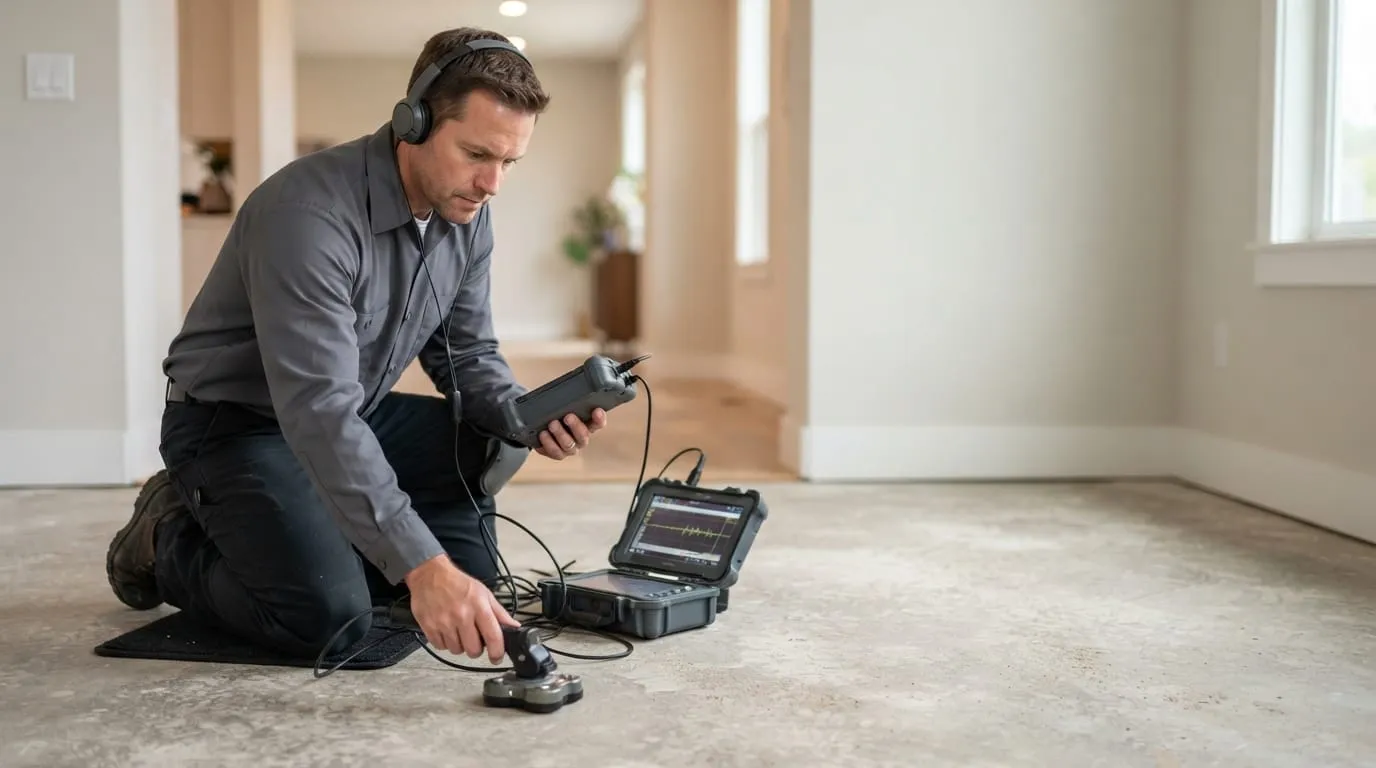
Acoustic listening equipment, thermal imaging and tracer gas or line-locating tools find the leak to within a small area so the repair opening is as small as possible.
Repair with the least disruption
Options are explained before any concrete or drywall is opened. For slab leaks that can mean a spot repair, rerouting the line overhead, or repiping if the pipe is failing in multiple places.
Other plumbing services in Los Angeles
- Water Heater Repair in Los AngelesDiagnosis and repair of gas, electric and tankless water heaters, including no-hot-water calls, leaks, pilot problems and sediment flushing.
- Sewer Line Repair in Los AngelesCamera-verified repair and replacement of cracked, collapsed, root-damaged or bellied sewer laterals, including trenchless lining and pipe bursting.
- Emergency Plumber in Los AngelesBurst pipes, sewage backups, no water and major leaks handled around the clock by licensed local plumbers who can be dispatched today.
- Drain Cleaning in Los AngelesProfessional clearing of slow or blocked kitchen, bathroom, laundry and floor drains using cabling, hydro jetting and camera inspection.
Leak Detection near Los Angeles
We also serve Alhambra, Burbank, Glendale, Pasadena, Santa Monica, Inglewood, Torrance, Long Beach, Culver City, Beverly Hills and the surrounding Los Angeles County area.
Questions
Leak Detection questions from Los Angeles homeowners
How do I know if I have a slab leak in my Los Angeles home?
The usual signs are a warm or damp patch on the floor, the sound of running water with every fixture closed, a water heater or pump cycling when nothing is in use, an unexplained jump in the bill, or cracking that appears in flooring without another cause. The quick test is the meter: turn off every fixture and appliance that uses water, then watch the meter's low-flow indicator. If it is still moving, water is going somewhere. That tells you there is a leak but not where it is, which is the part that needs equipment.
Why does a post-tension slab change the repair?
Because you cannot cut it freely. A post-tension slab has steel cables running through it under high tension, and cutting one during a repair is dangerous and expensive to put right. It means the leak has to be located precisely rather than approximately, the cable layout has to be established before any concrete is opened, and the access point has to be chosen around the cables rather than directly over the pipe. It also makes rerouting the line more attractive than it would be in a conventional slab, because rerouting avoids opening the floor at all.
What equipment is actually used to find the leak?
Usually a combination, because no single method works everywhere. Acoustic listening equipment picks up the sound of water escaping under pressure through concrete. Thermal imaging finds the temperature difference a hot water leak creates in the floor above it. Pressure testing isolates which line is losing water, hot or cold, supply or drain, by shutting sections off and watching what holds. Tracer gas is used where the leak is small or quiet. The point of using several is to narrow the position to a small area before anything is opened.
Can the leak be fixed without breaking the floor?
Often, yes, and in post-tension construction it is frequently the better option. Rerouting abandons the failed section under the slab and runs a new line through walls, ceilings or the attic to the same fixtures. It avoids the concrete entirely and it replaces pipe that was likely to fail again anyway. Where the rest of the system is sound and the leak is a one-off, a spot repair through a small opening is reasonable. Where the house has already had a slab leak or two, rerouting or repiping usually costs less over any sensible horizon.
My leaks keep coming back at different fittings. What is going on?
That pattern, several leaks in different places rather than one leak recurring, points at pressure rather than at any individual pipe. In the hillside and canyon parts of the city, static pressure can run far above what domestic fixtures and appliances are designed for if the pressure reducing valve has failed or was never installed. The leaks are the symptom. Until the pressure is measured and regulated, fixing each joint in turn just moves the failure to the next weakest point.
Learn more about leak detection nationwide, or see all California plumbers.
Get it fixed
Leak Detection in Los Angeles, ready now
Call with your Los Angeles ZIP code and what you are seeing. A licensed local plumber is dispatched and you get clear guidance in the meantime.
Free call-routing service. An independent licensed plumber does the work and quotes you directly.
- Licensed and insured
- Answered 24/7
- Price before work