Service
Sewer Pipe Relining
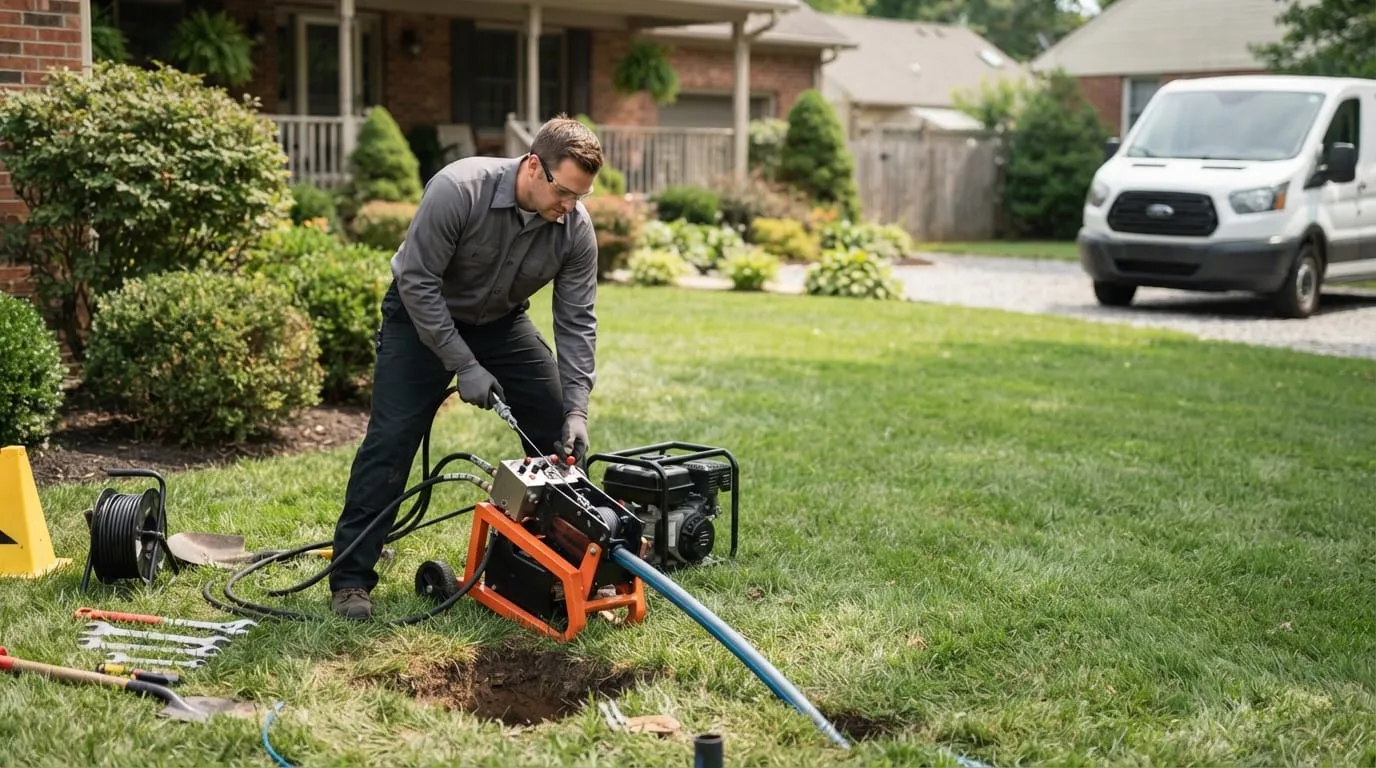
Curing a resin-saturated liner inside an existing sewer pipe to create a jointless new pipe, which removes the openings roots grow through.
Free call-routing service. An independent licensed plumber does the work and quotes you directly.
- Licensed and insured
- Price agreed before work
- A plumber who works your area
It works because it removes the joints
The reason relining ends recurring root problems is worth understanding, because it explains why cutting never does.
Roots do not break into sound pipe. They find moisture escaping from a joint that ground movement has opened slightly, then grow toward it and through it. Old clay laterals came in short lengths, which means a joint every few feet along the entire run: dozens of opportunities.
Cutting the roots clears the mass. The opening is untouched, the moisture still escapes, and within a season or two they are back in the same place.
A cured liner is continuous from end to end. There is no joint left to enter through.
Cleaning is not the preliminary, it is part of the job
A liner takes the exact shape of whatever it is cured against.
Roots left in place become a permanent lump in the new pipe. Scale left on the wall becomes a ridge. Debris becomes a bump that collects material for the next fifty years.
So the preparation, cutting back, scouring the wall, camera-checking that it is genuinely clean, is not a step to be rushed to get to the interesting part. It is the step that determines whether the finished pipe is smooth or permanently compromised.
Does this sound familiar?
Problems this service solves
- Roots returning through the same joints after every cutting
- A cracked lateral that still holds its shape
- Groundwater getting into the line through open joints
- A line under hard landscaping that needs structural repair
- Old clay pipe with joints every few feet
Signs you need sewer pipe relining
If more than one of these is true, the problem is usually past the point a plunger or a store-bought cleaner will fix.
- Roots regrow in the same place within a season
- A camera shows cracks and open joints but no collapse
- The line runs full but leaks or admits groundwater
- Repeated cutting has become an annual cost
What to expect
How the visit works
Confirm the pipe can take it
The camera checks shape and fall. Relining a bellied or collapsed section preserves the fault, so those are excluded before anything is ordered.
Clean the pipe thoroughly
Roots are cut back and the wall is scoured, because the liner cures against whatever is there and any debris becomes a permanent lump.
Install and cure
A resin-saturated liner is drawn or inverted into place and cured, forming a rigid, jointless pipe inside the old one.
Reinstate and verify
Any branch connections are reopened and a final camera run confirms a clean, continuous bore.
What's included
What you get on every job, whoever we send.
- No joints left for roots to grow through
- Around fifty years of design life
- The pipe cleaned properly before lining, not lined over debris
- Branch connections reinstated and camera-verified
Questions
Sewer Pipe Relining questions
Why does relining stop roots coming back?
Because it removes what they were growing through. Roots do not penetrate sound pipe; they find moisture escaping from a joint that has opened slightly and grow into the gap. A cured liner is continuous along the whole run with no joints, so there is nothing for them to enter. Cutting roots deals with the mass and leaves the opening, which is why the same spot fills again within a season or two.
Does the liner make the pipe narrower?
Slightly, but far less than people expect, and the practical effect is usually positive. The liner is thin, and the new interior surface is smooth, whereas the old pipe it replaced was rough, scaled or root-damaged. Flow characteristics generally improve rather than decline. The exception is a pipe that was already undersized for its load, where the small reduction is worth discussing.
Can any sewer pipe be relined?
No, and that is the honest limit of the method. The existing pipe has to hold its shape and its fall, because the liner cures against the inside of what is there. A section that has settled into a belly will still hold standing water afterwards. A collapsed section has nothing to cure against. This is exactly what the camera assessment is for, and it should happen before relining is offered as the solution.
Related services
Trenchless Sewer Repair
Repairing or replacing a sewer lateral without a full trench, using lining or pipe bursting from small access points, where the line allows it.
See what this coversSewer Line Repair
Camera-verified repair and replacement of cracked, collapsed, root-damaged or bellied sewer laterals, including trenchless lining and pipe bursting.
See what this coversSewer Camera Inspection
Putting a camera down the sewer lateral to find out what is actually wrong, because roots, offsets, bellies and collapses all cause the same backup.
See what this coversWater Heater Repair
Diagnosis and repair of gas, electric and tankless water heaters, including no-hot-water calls, leaks, pilot problems and sediment flushing.
See what this covers
Get it fixed
Sewer Pipe Relining, handled locally
Call with your ZIP code and what you are seeing. We route you to a licensed plumber in your area who does sewer pipe relining every week.
Free call-routing service. An independent licensed plumber does the work and quotes you directly.
- Licensed and insured
- Answered 24/7
- Price before work