Service
Trenchless Sewer Repair
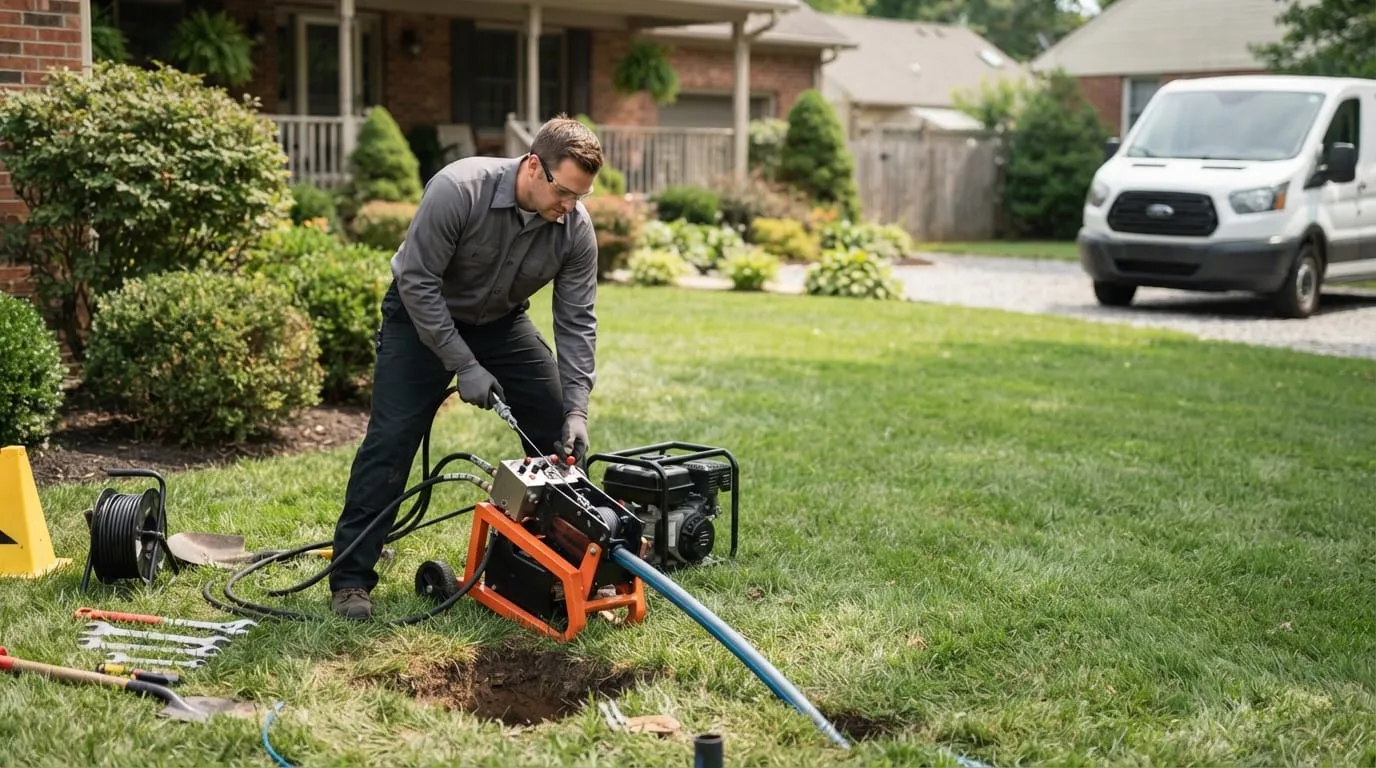
Repairing or replacing a sewer lateral without a full trench, using lining or pipe bursting from small access points, where the line allows it.
Free call-routing service. An independent licensed plumber does the work and quotes you directly.
- Licensed and insured
- Price agreed before work
- A plumber who works your area
The trench is rarely the expensive part
When people compare trenchless against digging on price per foot, trenchless loses. That is the wrong comparison.
An open trench across a driveway does not just cost the excavation. It costs the driveway. Add a patio, established planting or a mature tree and the reinstatement can exceed the pipework several times over.
So the honest comparison is total cost including putting everything back. Under hard landscaping, trenchless usually wins comfortably. Across an open lawn with good access, digging can genuinely be better value, and that is worth hearing from whoever quotes it.
What has to be true for it to work
Trenchless is a method, not a guarantee, and the camera decides.
Lining needs the existing pipe to hold its shape and its fall, because the liner is cured against the inside of what is already there. A belly stays a belly. A collapsed section cannot be lined at all.
Bursting needs a route it can be drawn along. Sharp changes of direction, unstable ground or something immovable in the path can rule it out.
Anyone promising trenchless before looking inside the pipe is guessing, and the point at which that gets discovered is halfway through the job.
Does this sound familiar?
Problems this service solves
- A failing lateral under a driveway, patio or mature planting
- A line that runs beneath a structure or hard landscaping
- A repair where reinstating the surface would cost more than the pipe
- A lateral needing replacement on a small or awkward lot
- Wanting minimal disruption to a working property
Signs you need trenchless sewer repair
If more than one of these is true, the problem is usually past the point a plunger or a store-bought cleaner will fix.
- The lateral runs under something expensive to reinstate
- An open trench would cross a driveway or established garden
- The line is failing along its length rather than at one point
- A camera shows the pipe still holds usable shape
What to expect
How the visit works
Assess by camera
Trenchless is not universally possible. The camera decides whether the pipe holds enough shape and fall for lining, or whether bursting is the better route.
Choose lining or bursting
Lining creates a new pipe inside the old one. Bursting destroys the old pipe and pulls new pipe through. They suit different conditions.
Prepare the line
The existing pipe is cleaned thoroughly first, because a liner takes the shape of whatever it is cured against, including any debris left behind.
Install and verify
The work is done from small access points and a final camera run confirms the result before anything is closed up.
What's included
What you get on every job, whoever we send.
- Driveways, patios and planting left intact where possible
- An honest assessment of whether trenchless actually applies
- Thorough cleaning before lining, not a liner over debris
- Camera verification of the finished pipe
Questions
Trenchless Sewer Repair questions
Is trenchless always cheaper than digging?
Not per foot, but often overall, and that is the distinction that matters. Trenchless work costs more as a method. What it avoids is the reinstatement: the driveway, the patio, the mature planting and the lawn that an open trench destroys. On a line running under a concrete drive, trenchless is usually cheaper all in. On an open lawn with easy access, digging can genuinely be the better value, and a plumber should be willing to say so.
When is trenchless not possible?
When the existing pipe cannot support the method. Lining needs the pipe to hold its shape and its fall, so a collapsed section or a belly rules it out, because a liner conforms to what it is cured inside and would preserve the sag. Bursting needs a route it can be pulled along, so sharp direction changes, unstable ground or obstacles in the path can prevent it. That is what the camera assessment establishes.
How long does a lined pipe last?
Cured-in-place liners are generally rated around fifty years, which is comparable with new pipe. The material is a resin-saturated liner cured into a rigid pipe inside the old one, and because it is jointless there is nothing for roots to enter through, which removes the most common cause of recurring blockages in older laterals. Ongoing maintenance is the same as any drain: keep it clear.
Related services
Sewer Pipe Relining
Curing a resin-saturated liner inside an existing sewer pipe to create a jointless new pipe, which removes the openings roots grow through.
See what this coversSewer Line Replacement
Full replacement of a sewer lateral that has collapsed, bellied or corroded past the point where lining or spot repair can work.
See what this coversSewer Camera Inspection
Putting a camera down the sewer lateral to find out what is actually wrong, because roots, offsets, bellies and collapses all cause the same backup.
See what this coversWater Heater Repair
Diagnosis and repair of gas, electric and tankless water heaters, including no-hot-water calls, leaks, pilot problems and sediment flushing.
See what this covers

Get it fixed
Trenchless Sewer Repair, handled locally
Call with your ZIP code and what you are seeing. We route you to a licensed plumber in your area who does trenchless sewer repair every week.
Free call-routing service. An independent licensed plumber does the work and quotes you directly.
- Licensed and insured
- Answered 24/7
- Price before work