
Service
Commercial Plumbing Repair
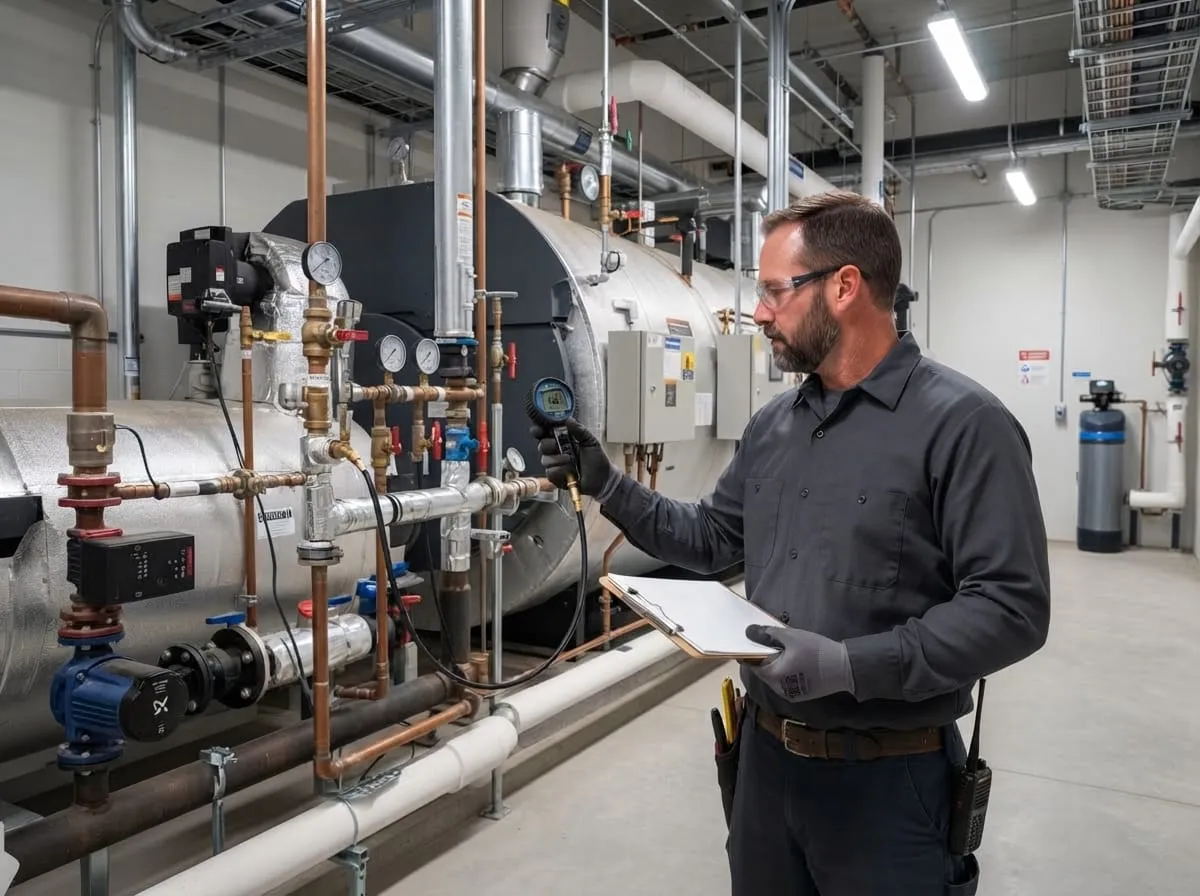
Repairs in commercial buildings, where the plumbing is heavier duty, the systems are shared and the real cost is usually the downtime.
Free call-routing service. An independent licensed plumber does the work and quotes you directly.
- Licensed and insured
- Price agreed before work
- A plumber who works your area
The repair is rarely the expensive part
In a commercial building the arithmetic is different from a house, and it changes what a good decision looks like.
A blocked drain in a restaurant is not a plumbing cost. It is a service that cannot operate. A washroom out of use in a retail unit is a customer problem. A leak into the tenancy below is somebody else’s stock.
So scheduling frequently matters more than hourly rate. Work done out of hours at a premium is often far cheaper overall than the same work done during trading, and it is worth pricing both rather than assuming.
The same logic applies to parts. Waiting a day for the correct commercial valve usually beats fitting a domestic substitute that fails again in a month.
Know what the valve shuts off
The practical difference between commercial and domestic work is that nothing serves only one thing.
A valve that looks like it isolates a washroom may feed a floor. A riser may serve tenancies with no connection to yours. Shutting the wrong one interrupts businesses that had no involvement in the problem.
So the isolation is mapped and confirmed before anything is turned, and the people affected are told beforehand rather than discovering it.
In a building with any complexity, that groundwork takes longer than the repair. It is also the difference between a routine job and a phone call from three other tenants.
Does this sound familiar?
Problems this service solves
- A failure affecting a whole floor or tenancy
- Fixtures out of use in a public washroom
- A leak affecting a tenant below
- Commercial-grade equipment needing specific parts
- Repairs that cannot happen during trading hours
Signs you need commercial plumbing repair
If more than one of these is true, the problem is usually past the point a plunger or a store-bought cleaner will fix.
- A fixture or a whole washroom is out of service
- Water is affecting another tenancy
- The failure is stopping the business operating
- Repairs keep recurring in the same place
What to expect
How the visit works
Establish what has to stay running
Which fixtures, floors or tenancies must remain in service shapes how the repair is staged before any tool comes out.
Plan the isolation
Commercial systems are shared. Knowing what a given valve shuts off, and who it affects, comes before it is turned.
Repair to commercial standard
Commercial fixtures and valves take heavier duty parts than domestic equivalents, and fitting a residential part is a repeat visit.
Schedule around the business
Work that will interrupt trading is done outside hours where it can be, because the downtime usually costs more than the repair.
What's included
What you get on every job, whoever we send.
- Continuity planned before work begins
- Isolation mapped so the wrong tenancy is not shut off
- Commercial-grade parts, not domestic substitutes
- Out-of-hours scheduling where downtime matters
Questions
Commercial Plumbing Repair questions
Why is commercial plumbing repair different from residential?
Three things. The equipment is heavier duty and takes different parts, so a domestic substitute fails quickly under commercial use. The systems are shared, which means isolating one fixture can affect a whole floor or another tenancy, and that has to be understood before a valve is turned. And the cost of the work is usually dominated by downtime rather than by labour, which changes how the job should be scheduled.
Can repairs be done outside business hours?
Usually, and it is often the cheaper option overall even at a higher hourly rate. If a repair means shutting off water to a floor of a restaurant or a busy retail unit during trading, the lost revenue generally exceeds the difference in labour cost by a wide margin. It is worth pricing the two options against each other rather than assuming normal hours is cheaper.
Who is responsible in a leased building, tenant or landlord?
It depends on the lease, and the practical dividing line is usually between what serves your unit alone and what serves the building. Fixtures and pipework inside the demised premises tend to be the tenant's; risers, mains and shared drainage tend to be the landlord's. Establishing which side of that line a fault sits on, ideally with evidence, is worth doing before the repair rather than after the invoice.
Related services
Commercial Drain Cleaning
Clearing commercial drains, which carry far more volume and far more grease than residential lines and block for different reasons.
See what this coversCommercial Plumbing Maintenance
Planned maintenance for commercial premises, scheduled around the failures that are predictable so they stop happening during trading hours.
See what this coversCommercial Sewer Services
Sewer work for commercial buildings, where a lateral failure affects every tenancy at once and the repair has to be planned around occupancy.
See what this coversWater Heater Repair
Diagnosis and repair of gas, electric and tankless water heaters, including no-hot-water calls, leaks, pilot problems and sediment flushing.
See what this covers

Get it fixed
Commercial Plumbing Repair, handled locally
Call with your ZIP code and what you are seeing. We route you to a licensed plumber in your area who does commercial plumbing repair every week.
Free call-routing service. An independent licensed plumber does the work and quotes you directly.
- Licensed and insured
- Answered 24/7
- Price before work