
Service
Commercial Plumbing Maintenance
Planned maintenance for commercial premises, scheduled around the failures that are predictable so they stop happening during trading hours.
Free call-routing service. An independent licensed plumber does the work and quotes you directly.
- Licensed and insured
- Price agreed before work
- A plumber who works your area
Some failures are on a timetable
The case for planned maintenance is narrower and stronger than it is usually made.
Most commercial plumbing failures are not random events. They are accumulations that reach a threshold.
Grease builds in a kitchen line at a rate set by what the kitchen does. Sediment builds in a water heater at a rate set by the water and the throughput. Commercial flush valves wear at a rate set by how many people use the washroom.
All of those can be predicted, which means they can be scheduled. And anything that can be scheduled can be moved out of trading hours.
That is the whole proposition: not preventing every fault, but moving the predictable ones onto a day you chose.
Start by finding out what is there
The first visit is usually the most useful, and it is not maintenance at all.
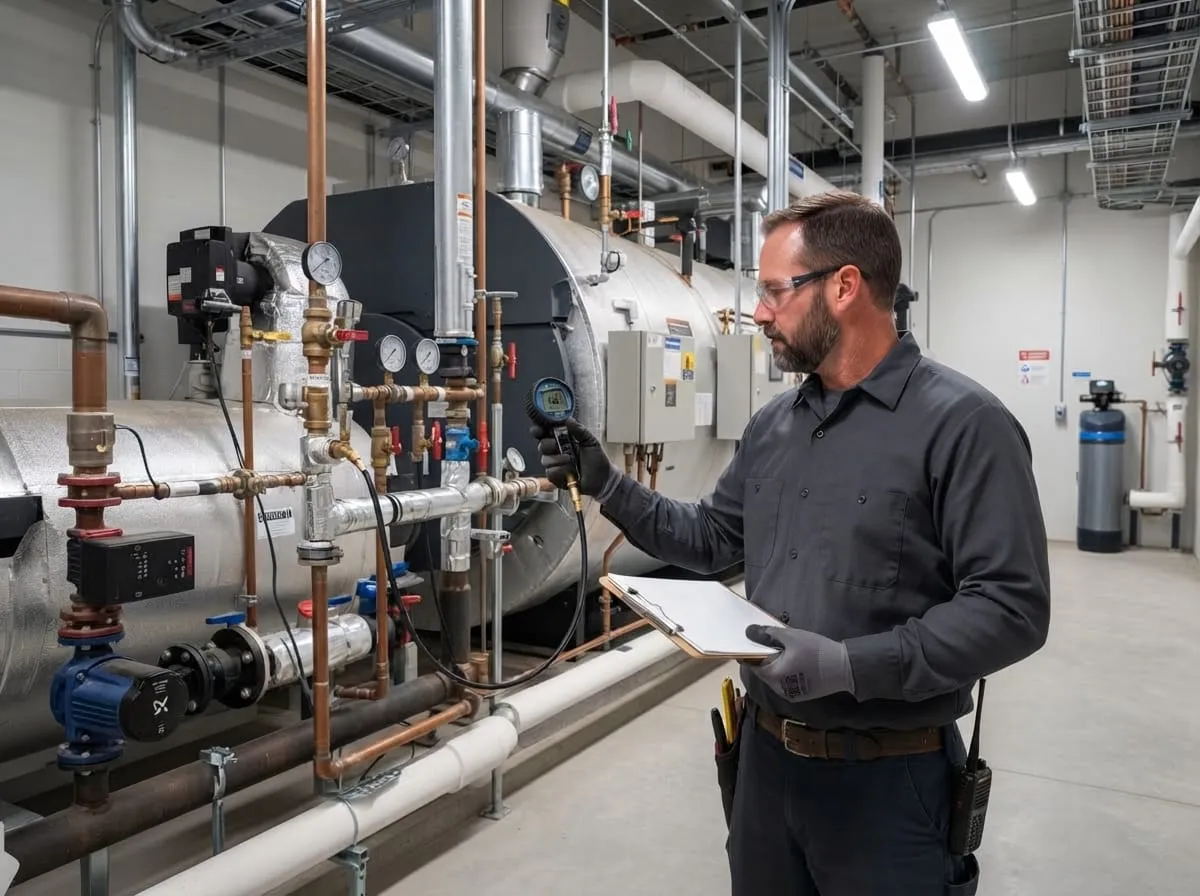
Most commercial premises have no accurate record of their own plumbing. Nobody knows how many isolation valves there are or what each one shuts off. Nobody knows when the water heater was last flushed, or whether the backflow device on the irrigation line is registered.
Documenting that, the fixtures, the heaters, the interceptors, the backflow assemblies and critically the isolation points and what each affects, changes how every subsequent job goes.
It also surfaces the compliance dates that tend to arrive as notices rather than as diary entries.
Does this sound familiar?
Problems this service solves
- Repeated emergency callouts for the same issues
- Drain blockages happening during trading hours
- Compliance dates being missed
- Water heaters failing without warning
- No record of what has been serviced and when
Signs you need commercial plumbing maintenance
If more than one of these is true, the problem is usually past the point a plunger or a store-bought cleaner will fix.
- The same failures keep recurring
- Emergency callouts have become routine
- Compliance notices arrive as a surprise
- Nobody knows when equipment was last serviced
What to expect
How the visit works
Survey what is actually there
Fixtures, heaters, interceptors, backflow devices and isolation points are documented, because most premises have no accurate record.
Identify the predictable failures
Grease accumulation, sediment in heaters and worn commercial valves fail on a timetable, which means they can be scheduled.
Set intervals from evidence
Each item gets an interval based on its actual duty and condition, not a generic schedule applied to everything.
Schedule and record
Work happens outside trading hours where it can, and every visit is recorded so compliance dates and service history are traceable.
What's included
What you get on every job, whoever we send.
- A documented record of what is on site
- Predictable failures scheduled rather than awaited
- Intervals set by duty and condition
- Compliance dates tracked instead of missed
Questions
Commercial Plumbing Maintenance questions
Is planned maintenance actually cheaper?
For the failures that are predictable, clearly so, because the comparison is not labour against labour. It is a scheduled visit outside trading hours against an emergency callout during service plus whatever the interruption costs the business. Grease-related drain blockages and water heater failures are the two that most often justify a maintenance arrangement on their own, because both are gradual and both fail at the worst time.
What should be on a commercial maintenance schedule?
The things that fail on a timetable rather than at random. Grease interceptor servicing and drain jetting where there is a kitchen. Water heater flushing and anode checks. Backflow testing, which is a compliance date rather than a choice. Commercial fixture valves and flush mechanisms, which wear far faster than domestic equivalents. Isolation valves, which need exercising so they still work when they are needed.
We already call someone when things break. Why change?
Because reactive works fine for genuinely random failures and badly for predictable ones. If the same drain blocks every few months, that is not an accident, it is an interval that has not been set. The value of a schedule is not that it prevents everything; it is that it moves the predictable failures out of trading hours and onto a day you chose.
Related services
Commercial Plumbing Repair
Repairs in commercial buildings, where the plumbing is heavier duty, the systems are shared and the real cost is usually the downtime.
See what this coversCommercial Drain Cleaning
Clearing commercial drains, which carry far more volume and far more grease than residential lines and block for different reasons.
See what this coversBackflow Testing
Annual testing and certification of backflow prevention assemblies, which most water authorities require and most premises forget until the notice arrives.
See what this coversWater Heater Repair
Diagnosis and repair of gas, electric and tankless water heaters, including no-hot-water calls, leaks, pilot problems and sediment flushing.
See what this covers

Get it fixed
Commercial Plumbing Maintenance, handled locally
Call with your ZIP code and what you are seeing. We route you to a licensed plumber in your area who does commercial plumbing maintenance every week.
Free call-routing service. An independent licensed plumber does the work and quotes you directly.
- Licensed and insured
- Answered 24/7
- Price before work