Service
Toilet Repair
Repair and replacement of running, leaking, clogged, weak-flushing and loose toilets, including wax rings, fill valves, flappers and flange repairs.
Free call-routing service. An independent licensed plumber does the work and quotes you directly.
- Licensed and insured
- Price agreed before work
- A plumber who works your area
Toilets are simple machines that fail in a handful of predictable ways, and most of those failures waste water or damage floors quietly for months before anyone notices. Our toilet repair service connects you with a licensed local plumber who fixes the cause rather than the symptom and tells you honestly when a replacement makes more sense.
Running toilets
A toilet that runs between uses is usually losing water through a worn flapper or a fill valve that does not shut off. It sounds minor, but a running toilet can waste hundreds of gallons a day, which shows up on the water bill and, in areas with tiered water rates, can be surprisingly expensive. The repair is quick with the right parts for that toilet model.
Leaks at the base
Water around the base of a toilet almost always comes from a failed wax ring or a broken flange, the fitting that anchors the toilet to the drain. Every flush pushes a little water under the toilet, where it soaks the subfloor. Resetting the toilet with a new ring, or repairing the flange, stops it. If the floor around the toilet is soft, that damage needs attention too.
Weak flushes and frequent clogs
Some toilets flush poorly because of mineral scale in the rim jets, a partial blockage in the trap, or a poorly designed early low-flow model. Others clog because the branch line or venting has a problem. The plumber checks the toilet itself first, then the drain if the toilet is sound, so you are not sold a new toilet when the pipe was the problem, or a drain cleaning when the toilet was.
Replacement
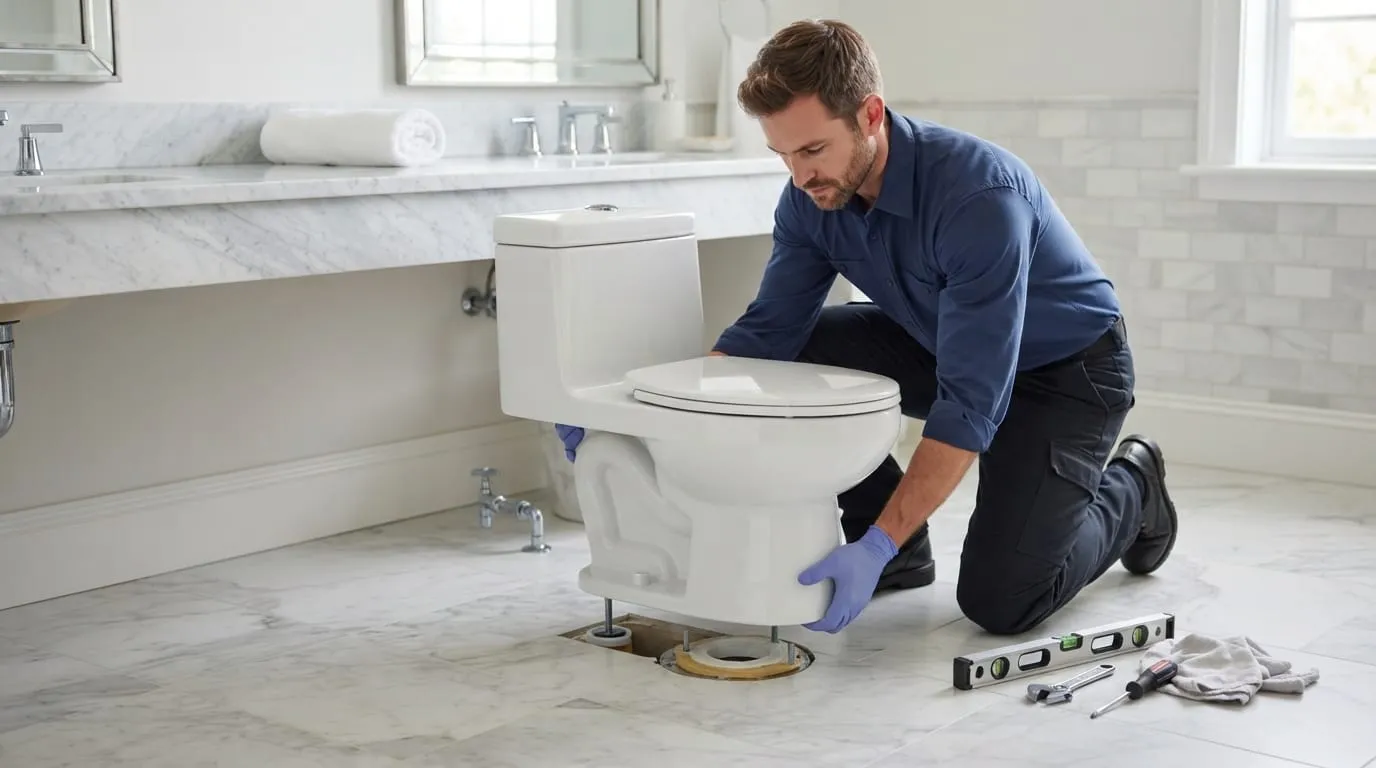
When a toilet is cracked, uses several gallons per flush, or keeps failing despite repairs, a modern replacement pays for itself in water savings and reliability. The plumber removes the old unit, checks the flange and floor, sets the new toilet with a fresh seal, connects a new supply line and shutoff, and tests it before leaving.
Does this sound familiar?
Problems this service solves
- Toilets that run constantly or cycle on and off by themselves
- Water seeping around the base from a failed wax ring or cracked flange
- Weak or incomplete flushes
- Frequent clogs in one toilet while others work fine
- Toilets that rock or have loosened from the floor
- Cracked tanks or bowls, and leaks at the tank-to-bowl gasket
- Supply valve or supply line leaks under the tank
Signs you need toilet repair
If more than one of these is true, the problem is usually past the point a plunger or a store-bought cleaner will fix.
- You hear the toilet refill when nobody has used it
- Water on the floor around the base, or a soft or stained floor near the toilet
- You need to hold the handle or flush twice to clear the bowl
- The toilet moves when you sit on it
- A sewer smell in the bathroom that comes and goes
- The water bill has risen with no other explanation
What to expect
How the visit works
Diagnose the actual cause
A running toilet, a base leak and a weak flush each have several possible causes. The plumber tests the fill valve, flapper, flush valve seal, water level, rim jets and the seal at the floor before recommending anything.
Repair with quality parts
Fill valves, flappers, flush valves, handles, tank bolts and gaskets are replaced with parts matched to the toilet model, not universal parts that fail early.
Reset or reseal at the floor when needed
A base leak means pulling the toilet, inspecting the flange, replacing the wax ring or installing a flange repair, and resetting the toilet level and tight.
Replace when repair is not worth it
A cracked bowl or tank, a very old high-consumption toilet with repeated problems, or a model with no available parts is replaced with a modern efficient toilet, properly set and sealed.
What's included
What you get on every job, whoever we send.
- The leak or running is fixed at the cause, not masked
- Water waste from a running toilet, which can be hundreds of gallons a day, stopped
- Floor and subfloor damage from base leaks caught early
- Replacement advice only when it saves you money or trouble
Questions
Toilet Repair questions
Why does my toilet keep running?
The most common cause is a worn flapper that no longer seals the flush valve, so water leaks into the bowl and the fill valve keeps topping up the tank. Other causes are a fill valve that does not shut off, a water level set too high so it spills into the overflow tube, or a chain that is too short. A plumber can identify which within minutes.
Is water around the base of the toilet serious?
Yes. It usually means the wax ring seal between the toilet and the drain flange has failed, and every flush is sending some water and waste under the toilet onto the subfloor. Left alone it rots the floor and can leak into the ceiling below. The fix is straightforward if done early.
Can a toilet be repaired or should I replace it?
Most toilets can be repaired for years with new internal parts. Replacement makes sense when the bowl or tank is cracked, when the toilet is a very old model that uses several gallons per flush and clogs frequently, or when parts are no longer available. A modern toilet uses a fraction of the water and flushes better.
Why does one toilet clog more than the others?
It may be an older low-flow model with a poor design, a partial blockage in the trap or branch line, mineral scale narrowing the rim jets and siphon jet, or a problem with venting. The plumber checks each and can tell you whether cleaning, a part or a replacement is the answer.
What should never be flushed?
Only toilet paper and human waste. Wipes labeled flushable, paper towels, feminine products, cotton swabs, dental floss and cat litter all cause clogs, either in the toilet or further down the sewer line where they are far more expensive to remove.
Related services
Sewer Cleaning
Clearing main sewer line blockages and root intrusions with heavy-duty cabling and hydro jetting, with camera inspection to confirm the line is clear.
See what this coversLeak Detection
Locating hidden water leaks under slabs, inside walls, in yards and at the meter using acoustic, thermal and pressure-testing equipment, then repairing them.
See what this coversFaucet Repair
Repair and replacement of dripping, leaking, low-pressure and stiff kitchen, bathroom, tub, shower and outdoor faucets, including cartridge and valve work.
See what this coversWater Heater Repair
Diagnosis and repair of gas, electric and tankless water heaters, including no-hot-water calls, leaks, pilot problems and sediment flushing.
See what this covers
Get it fixed
Toilet Repair, handled locally
Call with your ZIP code and what you are seeing. We route you to a licensed plumber in your area who does toilet repair every week.
Free call-routing service. An independent licensed plumber does the work and quotes you directly.
- Licensed and insured
- Answered 24/7
- Price before work