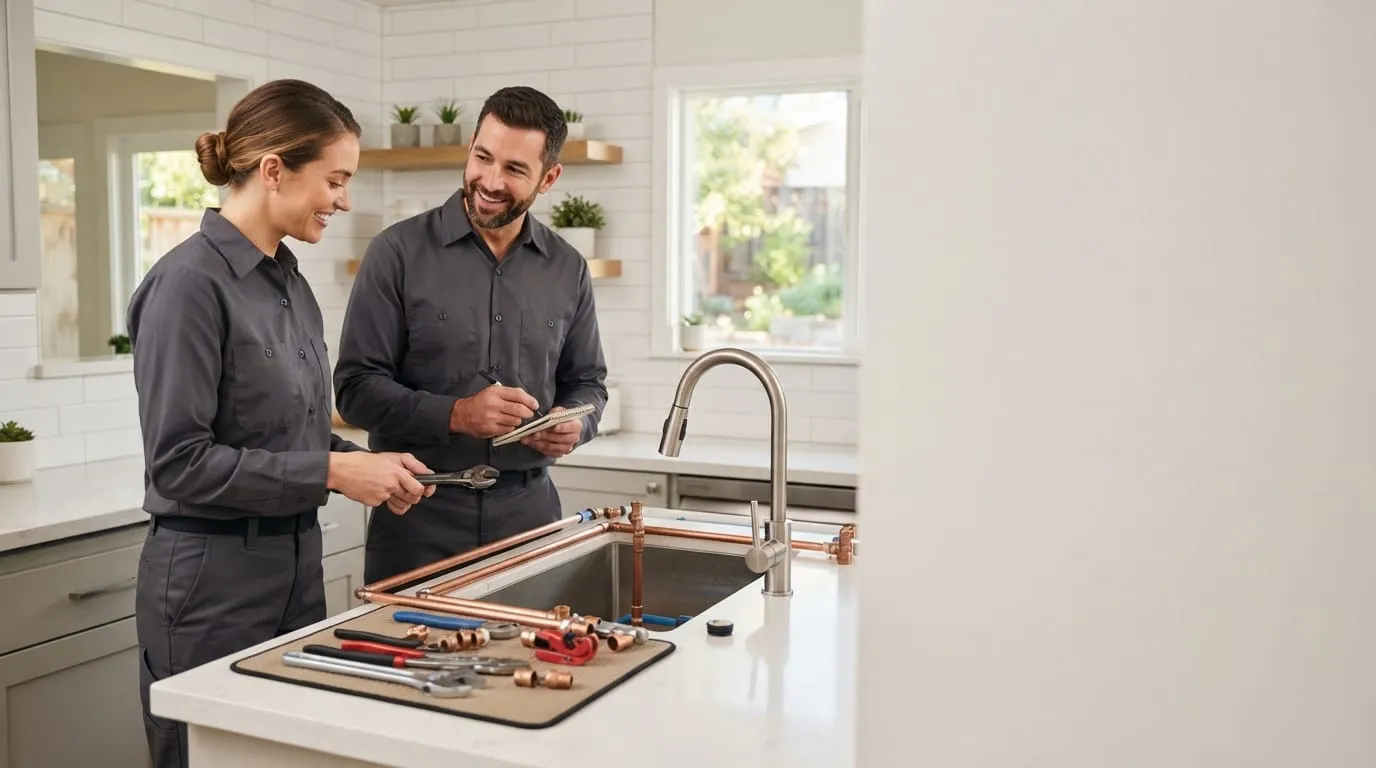
Tom Green County · Texas
Plumbers in San Angelo, TX
San Angelo sits in the Concho Valley where water is scarce, hard, and drawn from whichever source has anything in it that year. That shapes local plumbing more than anything else: scale in every heater, conservation as a habit rather than a campaign, and ground that moves as it dries through a long summer. San Angelo plumbers in our network work with all of it.
Free call-routing service. An independent licensed plumber does the work and quotes you directly.
- Tom Green County
- Texas licensed plumbers
- Answered 24 hours a day
Local plumbing problems
What goes wrong with plumbing in San Angelo
Very hard water and constant scale
Concho Valley water is hard, and scale is the default explanation for most equipment failures here. It builds on water heater elements and tank bottoms, coats tankless heat exchangers, blocks aerators and shower heads, and seizes valve cartridges long before they should wear out.
Slab movement through long dry summers
West Central Texas droughts pull moisture deeply out of the ground, and because the drying is uneven the slab above is supported unequally and moves. Copper cast into that slab moves with it, and hot-side lines give way first.
Old drainage in the historic centre
The oldest parts of San Angelo have drainage that has been in the ground a very long time, including cast iron and clay of an age where scaling, wall loss and settled bellies are normal rather than exceptional. Repeat blockages in the same place are the usual symptom.
Water heaters that fail early
A heater here does the same work as one anywhere while accumulating mineral deposits far faster. Tanks that should reach ten or twelve years frequently do not, and the difference between the ones that do and the ones that do not is almost always whether anyone flushed them.
Freeze damage in a hot-climate town
San Angelo gets genuinely cold nights and occasional hard freezes, and the housing is built around heat. Hose bibs, garage runs, attic lines and outdoor tankless units are what split, and February 2021 is the local reference for what an unprepared house looks like afterwards.
Hard water, and a figure that moves
Scale is the standing explanation for most equipment failures in San Angelo, and it comes with a local wrinkle worth knowing.
The hardness is not constant. The city draws on a combination of surface reservoirs and groundwater, and the balance between them shifts with drought conditions and what the reservoirs are holding in a given year. Different sources carry different minerals, so both hardness and taste can change over time in a way they do not in a city fed by a single lake.
What does not change is the effect. Minerals come out of solution wherever water is heated, so a tank builds a layer on the bottom that insulates the burner, and a tankless unit scales on its heat exchanger and quietly loses output.
The result is equipment that often does not reach its expected life. The difference between the tanks that do and the ones that do not is almost always whether anyone flushed them.
And because the figure moves here, a hardness test at your own tap is worth more than a number somebody quoted a few years ago.
A leak costs more than money here
In most cities, finding a hidden leak is a matter of the water bill. In the Concho Valley it is also a matter of a resource that is genuinely short.
Restrictions are a recurring feature of life here rather than an emergency measure, and a household leaking water continuously can find itself over a threshold without anyone having used more than usual.
That makes the meter check worth doing periodically rather than only when something seems wrong. Everything off, including irrigation, note the reading, come back an hour later. Movement means water is going somewhere.
If it has moved, isolating branches one at a time, the irrigation, an outbuilding, then the house itself, narrows which line is losing it before any equipment or digging comes into the conversation. It costs nothing and it removes most of the search.
Drought moves slabs
The Texas conversation about foundations usually concerns clay swelling after rain. Out here the damage comes from the other direction and it is just as real.
A long dry period pulls moisture deeply out of the ground. That drying is uneven, faster at the exposed edges of a slab than beneath the sheltered middle, so the slab ends up unequally supported and moves.
Anything cast into it moves too, and the hot water lines, which run warmer and cycle harder, are the ones that give way first.
Keeping moisture around the foundation consistent through a long dry spell is the standard mitigation. Evenness is the operative word: watering the side of the house with a convenient tap and leaving the rest creates exactly the differential you were trying to avoid.
An old town centre, and everything else
San Angelo has a genuinely old core, and the first useful question about a local plumbing problem is usually which side of that line a property sits on.
In the historic downtown and around Fort Concho, drainage has been in the ground a very long time. Cast iron and clay of that age have scaled, thinned from the inside and settled into low spots where water stands and solids drop out. The symptom is not a dramatic failure; it is the same drain blocking again, and again, in the same place.
On the newer edges of the city, drainage is PVC and the problems are the ordinary ones of hard water and ageing appliances.
A camera run is what settles which of those you have, and in the older areas it is worth doing before a third clearing of the same line rather than after.
San Angelo housing and infrastructure
The local factors that most often determine what a plumber finds and how a repair is done here.
Water from several sources, none of them abundant
The city draws on a combination of surface reservoirs and groundwater, and the balance shifts with drought conditions from year to year. That means both hardness and taste can vary over time, and it is one reason a test at your own tap is more useful here than a general figure.
Conservation as a standing condition
Water restrictions are a recurring part of life in the Concho Valley rather than an emergency measure. That makes leak detection more valuable than it might be elsewhere: a leak here wastes something genuinely scarce, and it can put a household over a restriction threshold without anyone using more water.
A semi-arid climate with real winter cold
Rainfall is low and evaporation high, but winter nights get cold and hard freezes occur. The combination catches people out, because the housing is designed entirely around heat in a place that occasionally is not hot.
A long-established town centre
San Angelo has a genuinely old core around Fort Concho and the historic downtown, with housing and infrastructure considerably older than the newer development on the edges. The first question about a local plumbing problem is usually which of those two the property belongs to.
Areas of San Angelo we serve
Neighborhoods and districts
- Downtown San Angelo
- Historic Old Town
- Santa Rita
- Fort Concho area
- Lake View
- College Hills
- Bluffs
- Bonham
- Southland
- Paulann
- Rio Vista
- Grape Creek area
- Belaire
- River Bend
ZIP codes we serve in San Angelo
76901–76906, 76909
From our approved service-area list. If your ZIP is not shown, call and we will check.
Nearby communities on our service list: Eldorado, Ballinger, Winters, Robert Lee, Bronte, Miles, Christoval, Mertzon.
Plumbers near San Angelo
Other cities in the area with their own local plumbing pages.
Questions
San Angelo plumbing questions
Is a water softener worth it in San Angelo?
For most households here the case is strong, and if you have a tankless water heater it is stronger still, because a scaled heat exchanger loses output steadily and eventually faults. The water is hard enough that scale is the normal reason equipment fails early. The right way to decide is a hardness test at your own tap rather than a general assumption, particularly here where the source mix shifts and the figure is not constant year to year.
Why does my water taste different at different times?
Because the source mix changes. The city draws on a combination of surface reservoirs and groundwater, and the balance between them shifts with drought conditions and reservoir levels. Different sources have different mineral profiles, so taste and hardness are not constant from year to year in the way they are in a city fed by a single reservoir. It is not a fault, and it is a good reason to test rather than rely on a figure someone quoted you once.
How do I find a leak I cannot see?
Start at the meter, because in a place where water is this scarce it is worth checking periodically anyway. Turn off every fixture and appliance including any irrigation, note the reading, and come back an hour later. If it has moved, water is escaping somewhere on your side. From there, isolating branches one at a time, the irrigation, an outbuilding, the house, narrows which line it is on before any equipment or digging is involved.
Why do my water heaters keep failing early?
Scale, in almost every case. Minerals settle out of hard water as it heats and build a layer on the tank bottom or directly on the elements. That layer insulates, so the heater has to push more energy through it to do the same work and the metal beneath overheats. Annual flushing removes it while it is still loose. Left for years it hardens onto the tank and no longer flushes, and the heater reaches the end of its life several years early.
Can drought really move a house slab?
Yes, and in West Central Texas it is a significant cause of slab leaks. Long dry periods draw moisture deeply out of the ground, and that drying is uneven, faster at the exposed edges of a slab than beneath the sheltered middle. The slab ends up unequally supported and moves, and anything cast into it moves with it. Keeping moisture around the foundation consistent through a long dry spell is the usual mitigation, with evenness being the important part.
What should I do before a hard freeze?
Deal with the exposed plumbing before the temperature falls, because in a town built for heat there is more of it than you would expect. Disconnect hoses and cover hose bibs, since a connected hose stops a frost-proof tap from draining and it will split. Insulate pipe in the garage and against exterior walls. Confirm any outdoor tankless unit still has power for its freeze protection. And find the main shutoff and check it turns, because a split pipe only starts leaking when it thaws.
Get it fixed
Need a plumber in San Angelo?
Describe the problem and your San Angelo ZIP code. We connect you with a licensed local plumber and tell you what to do while they are on the way.
Free call-routing service. An independent licensed plumber does the work and quotes you directly.
- Licensed and insured
- Answered 24/7
- Price before work